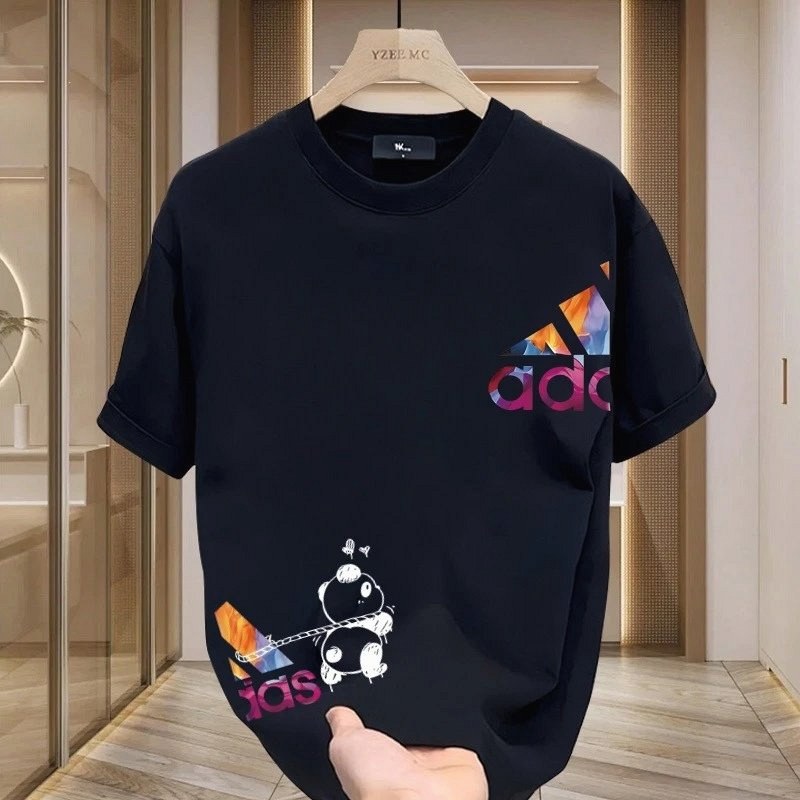
Most listings fail a buyer in one place. This one fails in three small places at once, and every one of them is visible before you pay if you know which field to read. We ordered SKU 7715699497 — the black crew-neck with the chest graphic and the cartoon motif near the hem — had it shipped through an agent to our Portland desk, and then spent a week measuring it against the page it came from.
What arrived, and the order trail behind it
The parcel reached us inside the window the seller quoted, though tracking sat still for most of the transit and only populated at the final hop. Inside: one folded black tee in a plain poly bag, no hangtag beyond a small woven neck label, no care card. The black dye read evenly across the body, the rib at the neck sat flat out of the bag, and the prints — the multicolored chest logo and the cartoon figure above the hem — were both sharp at the edges with no visible misregistration.
That is a reasonable opening for a shirt priced at $8.36, down from a listed $9.77. What the page does not tell you is how much of the shirt you are choosing when you pick an option row, so we started there.
The option matrix is really two products sharing one SKU
The selector carries 18 rows, and they are not 18 colours of the same garment. There are black and white in S through 3XL, and then a separate block of four rows labelled as the plain solid-white short-sleeve in M through XXL. Those four rows are the ones to slow down on. The printed shirt is the product the photos show; the solid-white rows are a different build with no chest graphic and no hem cartoon, sitting in the same buy box at the same price.
| Option group | Rows | What you actually receive |
|---|---|---|
| Black, S–3XL | 6 | Black body, chest graphic, hem cartoon |
| White, S–3XL | 6 | White body, chest graphic, hem cartoon |
| Plain white short sleeve, M–XXL | 4 | Solid white, no prints |
| Remaining rows in the table | 2 | Not photographed; ask the seller before selecting |
If the print is the reason you are buying, confirm the row name matches a printed variant. A solid-colour row at the same price is not a discount — it is a simpler shirt.
Two fit claims, one page
The English description calls the cut standard. The specification table calls it loose. Those are two different garments in the mind of a buyer, so we put a tape on the black size L and let the numbers settle it: the body runs relaxed through the chest and drops fairly straight, closer to the loose claim than the standard one, without the boxy shoulder line you get on oversized streetwear cuts.
| Flat measurement, size L (black) | Our tape |
|---|---|
| Pit to pit | 55 cm |
| Body length, shoulder to hem | 71 cm |
| Shoulder seam to seam | 50 cm |
| Sleeve opening, laid flat | 21 cm |
Against the size chart, that puts the L at the generous end. Buyers of other Adidas tees report the same inconsistency across lines — some tops run oversized, some true — and one 6'1", 200 lb buyer landed on XL in Originals while another went a size down. Because no review on the wider record covers this SKU, treat our numbers as one data point and ask the seller for a chart photo for the exact colour and size you pick.
The brand line nobody wants to read twice
The title, category and breadcrumb all say Adidas. The feature table under the product copy names a different brand — Jintian — and lists no production process. We are not going to resolve that from a photograph. What we can say is that the label in the neck of the shirt that reached us did not settle the question in Adidas's favour without ambiguity, and that the chest print is the only place the Adidas mark appears on the garment.
If branding is the reason you are buying, ask for a close-up of the neck label and the chest print on the actual unit before you pay. If the print and the price are the reason, the brand field matters less.
This is ordinary listing literacy rather than a scandal: the spec table and the marketing copy on agent catalogue pages are often written by different hands, and the mismatch is left in place. Read the table as the seller's own account of the goods and the title as the search term that found them.
Fabric, weight and the light test
The shirt is listed as pure cotton, thin, rated 180–250 g/m², with an antibacterial finish and a note that it suits teenagers. That weight band is wide enough to cover two quite different fabrics, and our 10 cm swatch weighed in at the lower end of it. Held against a bright window, a hand behind the black body showed as a soft shadow rather than a clear outline; on the white row it would not take much more to read through.
This matches the loudest complaint in the wider Adidas tee record, where buyers describe current shirts as thin and semi-sheer compared with older, thicker versions. It is a real limitation, not a dealbreaker at this price, and it points to how the shirt should be worn: as a single layer in warm weather, or under an open jacket, rather than as the opaque black tee you build an outfit around.
Washing is the other open question. One buyer reported noticeable shrinkage on an Adidas 3-Stripes tee, while Originals Essential reviewers report the opposite — good wash behaviour and retained shape. With no wash report for this SKU, we washed cool and dried flat, and the neck rib came back sitting square to the shoulder seams.
The value case, stated honestly
At $8.36 the shirt is not asking much. What it gives you is an even black dye, two clean prints, a flat neckline and a relaxed cut that layers without fighting a jacket. What it does not give you is a heavy hand-feel, a documented brand story, or a fit you can predict from the chart alone. Whether that is a good trade depends almost entirely on which of the 18 option rows you click and whether you asked one question before clicking it.
We scored it 4 / 5: good, with the option matrix and the brand field doing the work that keeps it off a 5.