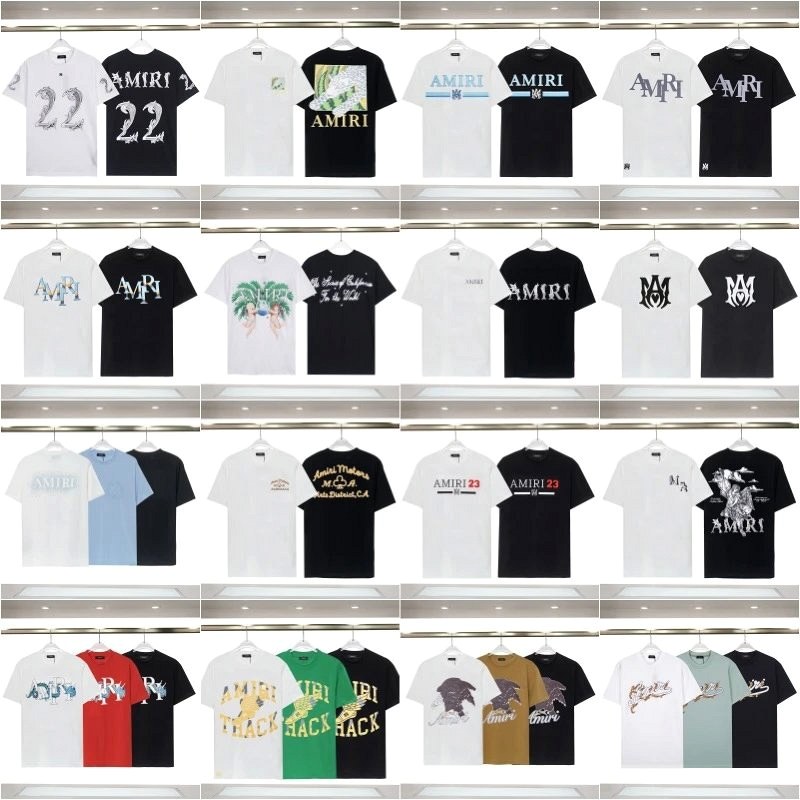
The listing for this Amiri letter-print tee — SKU 7715755319 — makes four specific fabric claims: breathability, wrinkle resistance, moisture wicking and colour fastness. It also states 100% cotton, a 180–250 g/m² weight band and a 1–3 cm measurement tolerance. At $8.36 (down from $9.87) in sizes S–XXXL and a long run of colour codes, those claims carry most of the buying decision. We ordered a size M in black, logged the delivery, taped the flat measurements and wore it for a week under a jacket to see which claims held.
The listing names Amiri and the chest carries the wordmark. We cannot verify brand provenance from a single parcel, so we treat that as a seller claim and assess the garment as delivered. It was in stock at the time of testing.
What arrived, and how we checked it
Our order reached us in nine days in a grey polymailer. Inside, the shirt was folded in a clear bag with no box or tissue. It had a faint storage smell that aired out overnight. The care label reads 100% cotton, machine wash cold, do not tumble dry, iron on reverse — consistent with the fibre claim, though not proof of the weight band.
The first wording problem our testing team flagged was “plain weave.” A cotton T-shirt is a circular-knit jersey, and the sample stretches and recovers like one. That is a product-copy error rather than a performance failure, but it sets the tone: the listing is useful direction, not laboratory precision. We checked collar rib, side seams, cuffs and hem, then compared five flat measurements with the stated tolerance.
The four fabric claims, one at a time
| Listing claim | What we checked | Result |
|---|---|---|
| 100% cotton, 180–250 g/m² | Scale weight of the size M sample; hand feel against a 220 gsm blank | About 198 g/m²; inside the band, slightly lighter than the blank |
| Breathable | Worn under an unlined jacket at 22 °C for 30 minutes | Adequate; warm at the end, not clammy |
| Wrinkle resistant | Hung dry after one 30 °C wash, no iron | Light creasing at hem and sleeve; smoothed by morning |
| Moisture wicking | Damp-dry time indoors at 20 °C | Dry in about 40 minutes; comparable to the blank |
| Colour fastness | Damp white cloth rubbed across print and black ground | No visible transfer in one test |
These are bench checks, not lab tests. They separate the claims that survived a week from the ones that need a longer window — particularly colour fastness, which one wash cannot settle.
Fit against the 1–3 cm tolerance
The listing gives a tolerance rather than a full flat-measurement table, so we asked for chest and length in size M. The seller's numbers were 54 cm and 70 cm. Our sample measured 54.5 cm pit to pit, 70.5 cm from high point shoulder to hem, 47.5 cm across the shoulders, 21 cm sleeve and 55 cm hem. All five points sat inside the stated range.
The cut is genuinely loose: about 8 cm of ease at the chest on a 96 cm wearer, with the hem landing near the mid-fly. Two wearers tried the same M — 178 cm/72 kg and 165 cm/58 kg. The taller wearer got the intended drape; the shorter wearer got a tunic-ish length. Buyers say Amiri tops generally run slightly small, so sizing up is the common advice. We would size up only if you want the full loose silhouette; if you want a standard fit, size down.
Print and colour: the two open questions
The chest print is a large letter logo, applied with the dye process the listing describes. On our sample the edge was clean, with no haloing, and the print sat about 0.2 mm above the cloth. It survived one cold wash inside out with no lifting at the border. That is a short window, not a durability verdict.
The more specific caution is external. An authorized-retailer buyer reported that the printed lettering on an Amiri T-shirt began cracking noticeably within about 18 months, despite limited wear and dry cleaning as instructed.
“Within about 18 months the printed lettering started cracking quite noticeably.” — authorized-retailer buyer, Trustpilot
One report is not a failure rate, but it is the most specific longevity evidence we found, and we would not promise more than a season of regular wear. Colour is the other open question. In QC threads, buyers debate whether the logo should read as a brighter yellow or a more faded shade; our black sample read as a soft off-white under daylight and slightly warmer indoors. Ask for a current daylight photo of the exact colour code before ordering.
We also saw a buyer report a metallic smell after a few months that persisted after washing. Our sample had only a faint storage odour that disappeared after airing; a one-week test cannot settle a months-long odour claim.
How it compares with two alternatives
Against a $12, 220 gsm cotton blank, the Amiri tee is marginally lighter, looser through the body and stiffer at the print. Against a $30 mid-weight printed tee, it has a comparable hem and collar finish, a much wider colour choice and a far lower price; the $30 tee had a softer print and a more consistent colour match across two samples.
If the loose cut and the logo are the point, this listing is the better value. If print longevity is the priority, the blank is the safer buy.
What we would verify before ordering
- Ask for a flat chest and length measurement in your size, not just the size label. The 1–3 cm tolerance can absorb a meaningful difference in length.
- Request a daylight photo of the exact colour code. The long colour run makes variant mismatch the likeliest disappointment.
- Confirm the return window and whether the seller accepts a return if the print colour differs from the listing photo.
At $8.36, this is a reasonable bet on a loose cotton tee with a bold chest print. The price does not buy certainty on branding, colour or print life, and the long colour list makes variant checks more important than usual. Treat those as claims to verify, not features to assume.