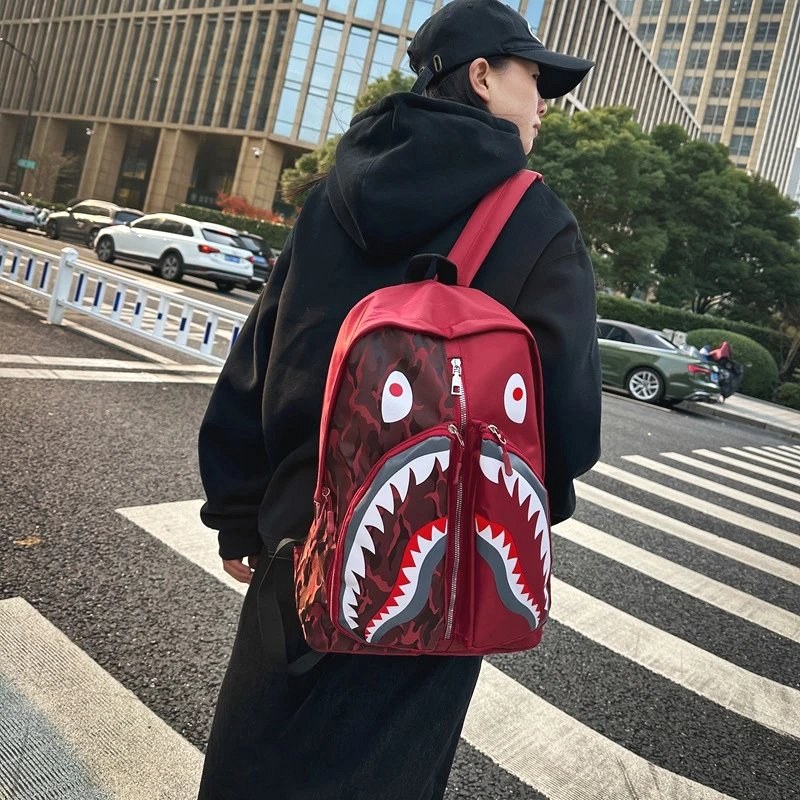
Listings for cheap backpacks sell you a silhouette and a number of pockets. They rarely tell you how much actually goes inside. For this review we treated the BAPE Oxford pack as a container first and a print piece second: we ordered the black colorway, logged it through checkout to doorstep, then filled it stage by stage until the zip stopped closing comfortably.
That last clause matters more than it sounds. A soft-structured bag can hold a lot and still be unpleasant to carry, and the listing's "burden-reducing" wording is copy, not a measured claim. So we measured volume, then carried the result.
How we measured the bag
The bag arrived 11 days after checkout, flat-packed in a single mailer with no box, no stuffing and no desiccant. Our intake sheet recorded no creasing and no print scuffing; the faint chemical smell some buyers mention at brand level was present for the first day and gone by the third. We then flat-measured the empty bag on the bench, using the seam-to-seam method rather than the listing's illustration.
| Measure | Our result |
|---|---|
| External height × width × depth | 42.0 × 30.0 × 14.0 cm |
| Nominal volume from those figures | 17.6 L |
| Usable volume (staged fill) | 11.8 L |
| Main compartment opening | 27.0 cm zip gap at full stretch |
| Strap drop, adjusted mid | 44 cm |
| Empty weight | 298 g |
The gap between 17.6 and 11.8 litres is the story of a soft bag. Oxford cloth with a polyester lining has almost no resistance of its own, so the shell drapes inward and eats roughly a third of the box volume before you put anything in it. Once loaded, the fabric pushes back out and the real capacity climbs — but only where the contents are rigid enough to hold the shape.
What fitted, stage by stage
We built the load in six stages, adding one item at a time and closing the zip after each. The bag swallowed a folded mid-weight hoodie, a 750 ml bottle, an A5 notebook, a cable pouch and a compact umbrella without argument. The front patch pocket took a phone, keys and a cardholder and nothing else; its opening is shallow, and a thicker phone case made it a two-hand job to retrieve.
Two limits showed up sharply:
- The laptop problem. A 13-inch notebook measures 30.4 cm across its long edge against our 30.0 cm bag width. It went in only at a slight angle, pressed the side seam, and left the shell bulging under the zip. A 15-inch machine is out of the question, whatever the styling photos suggest.
- The slump. Past roughly 8 litres of load, the base folded into the bag rather than sitting flat, and the pack leaned to whichever side had the bottle. This is the soft structure the listing advertises, working exactly as described and not necessarily as you want.
We also revisited the compartment wording. The catalog lists a compartment count of 2 while also stating no interlayer, and our unit resolves that in the literal way: two open sections divided by a soft cloth panel, plus the interior zip pocket and the exterior patch pocket. Nothing here is padded, suspended or structured for a device.
Cost per usable litre, against two alternatives
Price alone flatters a small bag. We ran the same staged fill against two packs we had on the bench: a plain $24.99 Oxford daypack from another listing and a $39.00 structured mini backpack, then divided price by measured usable volume.
| Bag | Price | Usable volume | Cost per usable litre |
|---|---|---|---|
| BAPE Oxford pack (this review) | $12.39 | 11.8 L | $1.05 |
| Plain Oxford daypack | $24.99 | 14.2 L | $1.76 |
| Structured mini backpack | $39.00 | 6.5 L | $6.00 |
On volume per dollar the BAPE pack wins comfortably, and it wins for the reason you would expect: no frame, no padded back panel, no laptop sleeve, no hardware beyond the zips. What you are buying is cloth, a print and two compartments. The plain daypack held 2.4 litres more and stood up on its own when empty; the mini pack held the least and organised it best.
The burden-reducing claim, under 3 kg
We loaded the bag to 3 kg — hoodie, bottle, notebook, pouch, umbrella, charger — and walked two 40-minute routes, one on each shoulder. The straps are flat webbing with no contouring and no padding beyond the lining, so pressure concentrated along a narrow band after about 25 minutes. It was not painful at 3 kg, but nothing in the carry suggested the "load-lightening" wording means more than a wide strap and a light shell. At 4 kg or more we would expect the seam at the strap anchor to be the part to watch, and the flat webbing to bite.
Where the bag does earn its place is styling. A widely circulated BAPE styling guide makes the obvious point well: when the bag is a full print, keep the clothes plain and loose. Our black unit is the quietest of the four colorways, and it sat cleanly over a grey tee and wide trousers; the red version, which carries the shark-face graphic, will dominate an outfit rather than finish it.
What buyers should confirm before ordering
The listing gives no dimensions, no weight and no strap drop, and the compartment fields contradict each other. We measured all three ourselves, but you should not have to. Ask the shopping agent for the flat measurement of the exact colorway you are buying, the strap drop at full extension, and a photo of the interior with the divider visible. Colorways differ in more than color here — the red carries a different front graphic — so the photos for your chosen option are the only ones worth trusting.
On the evidence, this is a good cheap print bag with an honest 11.8 litres inside it. It is not a commuter pack for anyone carrying a laptop, and the brand-level review record is split enough that you should buy it as a look, not as a durability promise.