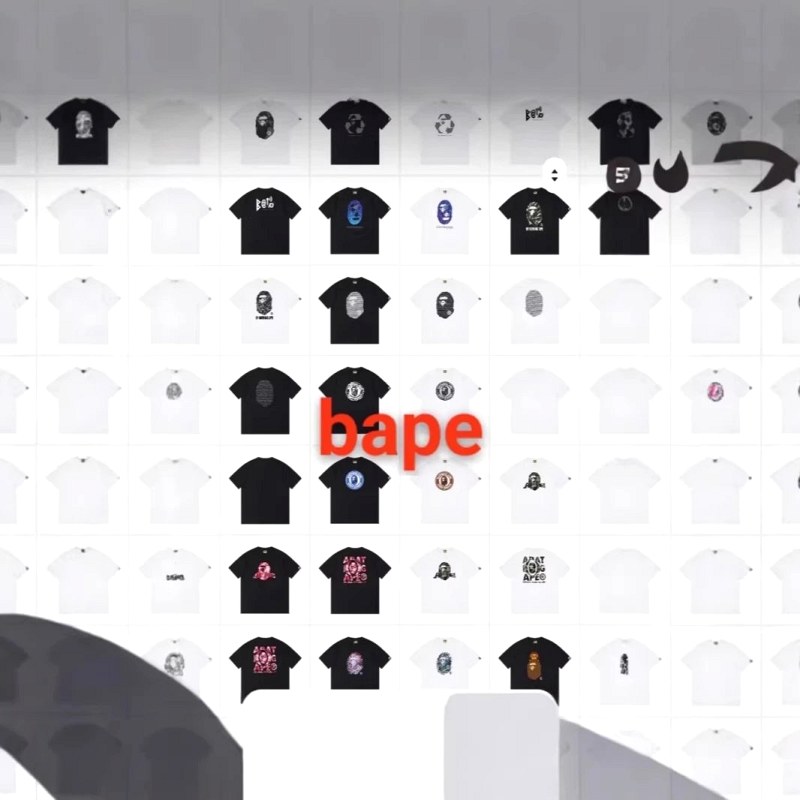
The listing for this Bape graphic tee sells two things at once: a fabric spec of 250–300 g with moisture-wicking function, and a heat-transfer print on a straight-cut cotton crew neck. Those two claims pull in different directions once the parcel is open, and that tension is what our bench spent most of its time on. We ordered SKU 7705005398 at $19.70, marked down from $22.46, and treated it like any other graphic tee that crosses the table.
What arrived, and how we handled it
The tee came folded in a plain poly mailer with no inner wrap and no hangtag beyond the neck label. We logged order-to-door timing, photographed the parcel, then laid the shirt flat and measured chest, body length and sleeve on the garment itself — because the listing, notably, does not publish a single measurement. Sizes run S through XXL with a straight cut, and that is the entirety of the fit information a buyer gets before checkout.
Two reference tees from our bench stayed on the table throughout: a heavyweight 250 g crew neck we use as a fabric control, and a budget screen-print tee we use as a print-durability control.
The 250–300 g claim against the scale
The catalogue lists a main fabric of pure cotton, a weight band of 250–300 g, and moisture-wicking as a function. On our postal scale the shirt read lighter than the 250 g control, and in the hand it behaves like a standard summer jersey: dry, slightly slick, with a little body but no real heft. That is consistent with what buyers of recent Bape tees have described — fabric that feels lighter and smoother than older, rougher cotton, with one comparison to Uniqlo's Airism knits rather than traditional heavyweight cotton.
We would not call the weight spec wrong, because the listing never says whether that figure covers the finished garment or the greige knit. That ambiguity is the seller-claim problem in one line: a number precise enough to look reliable, attached to no unit of measurement a buyer can check.
| Listing claim | What our bench observed |
|---|---|
| Pure cotton, 250–300 g weight band | Lighter than our 250 g control; dry hand, low loft, no visible transparency in black |
| Moisture-wicking function | No measurable wicking advantage over the cotton control in our wear log; treat as a marketing line |
| Heat-transfer print, creative motif | Clean edges at unpacking, matte finish, no trapped air bubbles visible under oblique light |
| Straight fit, S–XXL | Roomy through the chest and body; no published measurements on the listing |
| Pattern: random | Motif varies by color code; the option you select drives what arrives |
The print is the part that needs a calendar, not a loupe
Out of the bag the transfer was the best-finished thing about the shirt: sharp edges, even ink lay, and no halo around the motif. We then ran two cold, inside-out washes on a gentle cycle with mild detergent and hung it to dry, because heat is the documented enemy of heat-transfer graphics on this style of tee and buyers routinely report cracking within a few wears.
After wash one, the print face was unchanged. After wash two, we could see faint surface crazing along the densest edges of the motif under raking light — not a crack, but the first stage of one. That matches the buyer reports we found, and it is why the durability handling in the write-up centres on the laundry routine rather than the transfer technique itself. There is nothing delicate about cold water; there is something delicate about a dryer.
Heat is the shared culprit in both reported problems: cracked prints and shirts that come back a size smaller than they went in.
Fit without numbers
Bape tees are widely described as running large, with an XL fitting quite big and an L looser than expected. Our sample behaved the same way: the body was roomy enough that the shoulder seam sat past the natural shoulder on our regular-fit wearer, and the hem hung straight with no taper. If you want a conventional fit, size down; if you want the boxy streetwear silhouette the listing photographs suggest, take your usual size and accept the volume.
The practical problem is that you are choosing blind. Before ordering, ask the seller for a flat chest and body-length measurement in the exact size and color code you want, and get it in writing. The listing gives you five letters and a cut description; that is not a size chart.
Seventy-nine color codes and one random-motif note
The color run is enormous — roughly 79 codes spanning white, black, and multi-tone variants — and the spec sheet marks the pattern as random. In practice that means the black-and-white graphic you saw in position one of the gallery is not necessarily the graphic attached to the code you click. We would confirm the specific motif with the seller in the same conversation as the measurements. It is the single most useful pre-purchase step on this listing.
Tag, label and logo checks
Our sample carried a neck label and a wash label with legible print, and we went through the standard checks: the mouth shape on the ape logo, the ® placement and boxiness on the tag, and the print quality of the care label. This is a marketplace-sourced garment with an "own brand" style spec sheet, and reviewers of comparable items have flagged thin cotton and poorly spaced tag and patch work, so the label inspection is worth five minutes on arrival. One buyer also reported a faint odor straight out of the bag; ours smelled of nothing in particular after an airing.
How it scored
A 4 / 5, which on our scale means good rather than excellent. The print finished well, the black is opaque, and the price is honest for what arrives. What keeps it out of the top band is the combination of a weight claim nobody can verify, a fit with no published numbers, and a heat-transfer graphic that asks you to change your laundry habits to survive past the third wash. Care instructions worth taping to the machine: cold, gentle, inside out, mild detergent, no dryer, and never a hot iron near the motif.