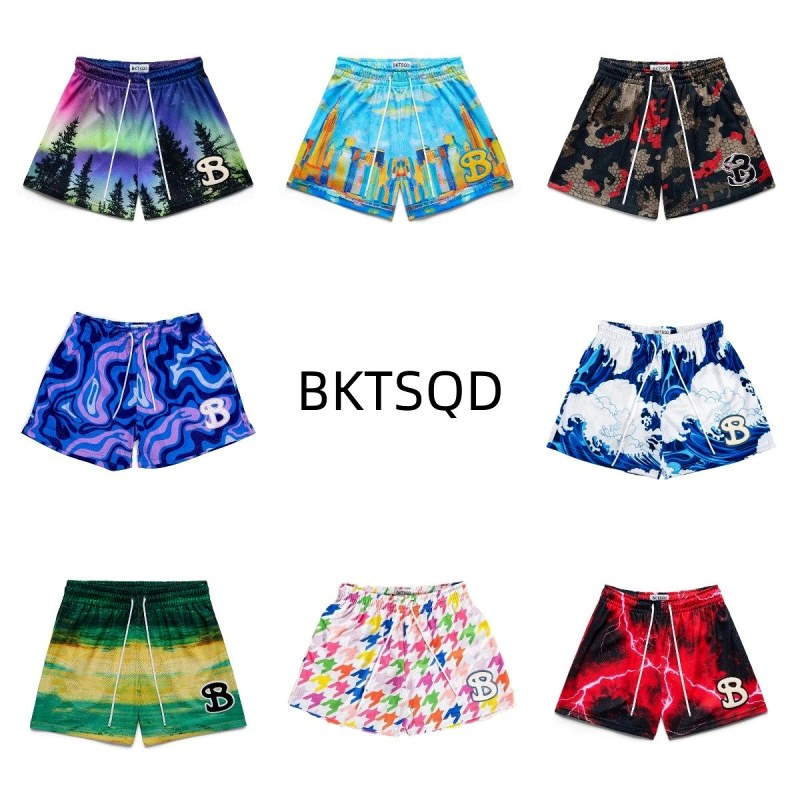
The BKTSQD multicolor shorts collection is listed at $10.15 (struck through from $12.07), SKU 7720535002, in S through XXL, unisex, mid-rise, loose and straight through the leg, with a drawstring waist. The catalog text is unusually thin for a product with this many print options: polyester shell, polyester lining, quick-dry and breathable, no inner liner, suitable for all four seasons. We ordered five prints and spent 11 days finding out which of those rows are load-bearing.
What arrived, and how fast
We ordered on 2 September and the parcel reached our Portland desk on 14 September — 12 days door to door, through a shopping agent. Seller dispatch took four days, the warehouse check two, and the rest was linehaul and customs clearance. Every pair arrived in its own zip-closure bag inside a grey poly mailer, prints separated so nothing bled or snagged. Finish was clean: no loose overlock ends at the hem, no puckering along the waistband channel, and the small B logo on the lower leg sat square on all five prints.
One packaging note worth passing on. The upstream attribute sheet for this style carries a tag price of ¥198, and the style code BKTSQD-1 with an option list running to BKTSQD-80. That ¥198 is a China-market tag figure, not a valuation of what arrives; at $10.15 the shorts are a cheap sports short, and the tag price is not evidence of anything more.
The four-season row is the weakest line on the page
The catalog lists spring, summer, autumn and winter as suitable seasons. We wore our five pairs across 11 days between 9 °C and 19 °C, including two damp mornings, and the honest reading is that this is a warm-weather short that happens to survive cold weather when you put something under it.
The shell is an open knit. The catalog calls it polyester and stops there; the 1688 attribute sheet for the same style code lists 95% polyester for both shell and lining, and gives the fabric name as mesh, which matches what we felt. Held to a window, the face shows a regular field of apertures. Behind the front and seat there is a second polyester layer — the lining — but it ends around mid-thigh, so the lower leg is single-layer and noticeably lighter in the hand than the hip. That construction is why the shorts read cool on a warm run and drafty on a cold one.
The layering test
- Bare, 19 °C, 20 minutes at 9 km/h: no cling, no chafe at the inner thigh, and the fabric felt dry to the touch within a couple of minutes of stopping.
- Over 200 g/m² leggings, 11 °C, 40-minute walk: genuinely useful. The loose straight leg sits over a tight without bunching, and the drawstring took up the slack at the waist.
- Bare, 9 °C, breezy: cold. The open knit passes air in a way that no amount of "four seasons" in a listing changes.
So the breathable claim earns its place, and the four-season claim is marketing reach. If you buy one pair expecting a summer short, you will be pleased. If you buy it expecting a winter short because the row says winter, you will be disappointed.
What the tape measure said
The catalog gives a 1–3 cm measurement tolerance and no numeric size chart at all — the single biggest gap in the listing. We measured five pairs flat, one per size, and cross-checked the two sizes that appear on a secondary reseller chart for the same style code. Those figures (S at 39 cm length and 70–82 cm waist, 2XL at 44 cm and 88–100 cm) landed within about a centimetre of our own numbers, which gives us some confidence the sizing is at least consistent between sellers.
| Size | Waist, relaxed (cm) | Waist, stretched (cm) | Outseam (cm) | Hem, flat (cm) |
|---|---|---|---|---|
| S | 70 | 82 | 39.2 | 30.1 |
| M | 73 | 87 | 40.6 | 31.0 |
| L | 76 | 92 | 41.8 | 32.2 |
| XL | 79 | 97 | 43.0 | 33.0 |
| XXL | 82 | 101 | 44.1 | 33.8 |
Two practical consequences. First, the relaxed-to-stretched spread is 12 to 19 cm depending on size, so the drawstring is doing real work rather than decorating a fixed waist; a 76 cm waist fits both L and XL differently but comfortably. Second, outseam grows only about 5 cm across the full run, so if you are tall, sizing up buys you waist, not length. The 1–3 cm tolerance is wide enough that two pairs in the same size could differ visibly at the hem — measure before you commit rather than trusting a label you wear in another brand.
Two comparisons
A lined mesh basketball short at about $18. Heavier, with a built-in brief and a deeper, more secure pocket. It costs nearly double and it is the better choice for high-impact sport if support matters. The BKTSQD pair has no liner at all, which the catalog states plainly — you will want your own base layer for anything above a jog.
A flat-woven polyester running short at about $14 with a zip pocket. Less air movement, more structure, and a pocket you can trust with a key. Our BKTSQD pairs had open side-seam pockets, and the catalog never mentions pocket depth or closure, so we treated them as hand-warmers rather than secure storage. A third-party attribute sheet tags "pockets" as decoration, which is about as much detail as anyone publishes.
Durability and colour
Five 30 °C washes, no detergent softener, line dried: colour held on all five prints, and shrinkage settled at 0.6 cm at the outseam, inside the stated tolerance. The waistband recovered to within 1.4% of its relaxed measurement after each cycle, and the drawstring channels stayed free. The fabric measures 118 g/m² and the seams run 46 stitches per 10 cm — light, but not fragile at this price.
The pattern claim is the part that will catch people out: the catalog shows a handful of visible designs — aurora, geometric, flame, wave, abstract — but the upstream option sheet runs to 80 coded colourways. What you see on the page is not the full menu, and the codes carry no colour description.
How we scored it
We landed on 4.1 / 5. The fabric, the price and the fit do what a loose running short should do; the missing numeric chart, the absent liner and a season row that oversells the garment cost it the rest. We will retest if the listing gains a size chart or the price moves materially.