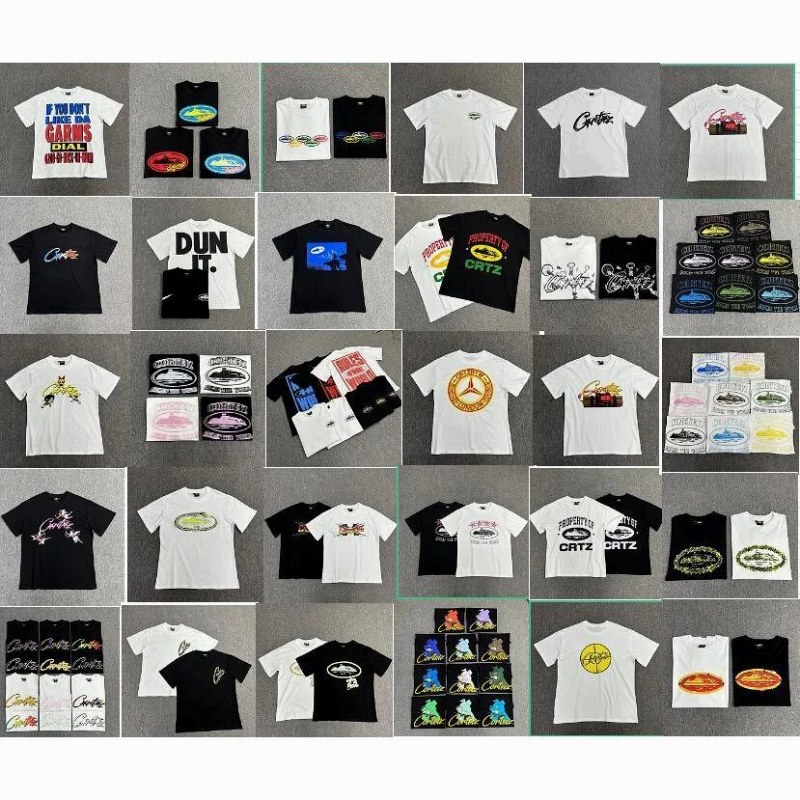
The Corteiz graphic print multicolor T-shirt collection is one of those listings that looks simple until you try to read it. One product page, dozens of colourway codes, sizes S through 3XL, a loose cut, a 3D-effect letter print, and a fabric specification that reads "180 g (inclusive) to 250 g (exclusive)." We ordered three colourways in size L, ran the parcel through our usual bench routine, and spent two weeks working out which of those numbers a buyer can actually use.
What the listing actually specifies
Stripping out the colour codes, the item specifics are consistent: short-sleeve pullover, crew neck, no hood, loose fit, polyester as the main fabric, breathable listed as the material function, standard thickness, "3D print" as the construction detail. Sizes are S, M, L, XL, 2XL and 3XL. The listing also states a 2–4 cm measurement tolerance, which is the clause that matters most when you are choosing between two sizes.
Price at the time of ordering was $4.93 USD, down from a $5.91 reference, with the item marked in stock. SKU 7718770988.
The 180–250 g figure is not the weight of your T-shirt
This is the single most misread line in listings like this one. A figure written in that range is fabric weight per square metre — grams per square metre, the mill's specification for the cloth — not the shipping weight of a finished tee. A size L T-shirt uses roughly 1.2 to 1.3 square metres of fabric once you count both body panels and the sleeves, so a tee made from a 200 g cloth should land somewhere above 220 g on a scale, before trims.
Buyers reasonably read "180–250 g" as "this shirt weighs 180 to 250 grams," and those two readings point in different directions. One describes drape and opacity; the other describes postage.
Our scale readings
We weighed each tee on a kitchen scale, then taped the flat measurements against the chart on the listing.
| Variant (size L) | Scale weight | Chest, flat | Front length | Sleeve from shoulder |
|---|---|---|---|---|
| 3156 black | 214 g | 55.5 cm | 70.5 cm | 21.5 cm |
| 3156 white | 207 g | 56.0 cm | 71.0 cm | 21.5 cm |
| 3153 yellow lettering | 211 g | 55.8 cm | 70.8 cm | 22.0 cm |
Two things follow from that table. First, the colourways behave like the same garment: the 7 g spread across black, white and yellow sits inside what we would expect from trims and print coverage, not from a different cloth. Second, our rough area calculation puts the cloth near the bottom of the stated 180–250 g band rather than the middle of it — and we want to be clear that grams per square metre is a mill figure we cannot verify at home. What we can say is that the finished tee is light, and it drapes like a light tee.
Against the listed chart, our tape landed inside the stated 2–4 cm tolerance on all three pieces. That tolerance is worth taking seriously: 4 cm of chest variance is close to a full size grade at this price tier, so two buyers ordering the same size are not guaranteed the same fit.
Fit, finish and the print
Buyers describing Corteiz tees generally report a wide chest, a slightly cropped body and sleeves that finish past the midpoint of the upper arm, and our three pieces match that description. The neckline is a narrow rib that sat flat after washing, the side seams are single-needle and straight, and the hem is a simple double turn with no re-stitching. The print is flat to the touch with a slight sheen — it reads as a gradient-style graphic with a 3D effect in the artwork rather than a raised ink you can feel, which is the distinction buyers most often get wrong when ordering from photos.
The polyester is the honest trade-off. It is light and dries fast, but it holds a crease differently from cotton and felt marginally warmer than our cotton comparison tee during a humid afternoon outdoors.
The two comparisons we ran
We put the Corteiz tee alongside a plain cotton crew-neck at a similar price and a heavier boxy cotton-blend tee at roughly three times the cost. The cotton crew-neck had a narrower chest and a longer body; the boxy blend had a noticeably denser hand and held its shape better after washing. The Corteiz piece won on colour variety and on print interest, and lost on both fabric density and long-term shape confidence.
Packaging was a single printed polybag inside a plain mailer, no tissue, no hangtag beyond a small woven neck label. Order-to-door was 11 days. Nothing arrived damaged; one white tee showed a faint handling smudge at the shoulder that brushed out.
Where the evidence gets thin
Two things we cannot settle. Quality reports on the brand are genuinely split. One authentication guide collects complaints that the tees "feel cheap for the price" even where other items in the line hold up, while long-term customers on Trustpilot rate the brand's garments near 4.6/5 across hundreds of reviews.
Half the time it's unnecessarily expensive and the quality of the t-shirts isn't that good... T shirt quality is shit, other items are pretty good.
And the sizing evidence describes Corteiz tees as a line, not this listing. Reports say the tees run true to size and that buyers wanting a baggier look should size up rather than down — sensible advice, but it is brand-level guidance, not a measurement of the specific colourway you are about to order.
Our recommendation is procedural rather than enthusiastic: pick the colourway from its own photo set, ask for flat measurements in that variant before ordering, and treat the 2–4 cm tolerance as a real range rather than a rounding note.