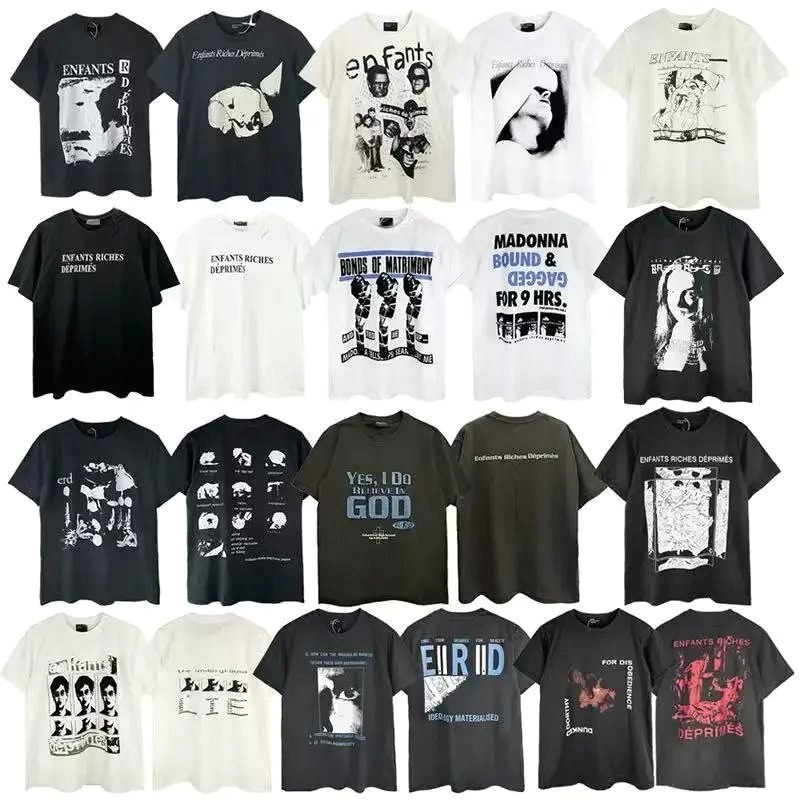
The ERD multicolor T-shirt collection is a $8.51 cotton tee (down from $10.10) sold under SKU 7718782900 in sizes S–XXL across a colour list dozens of codes long, including plain and pocket variants. Our testing team ordered nine units in six colour codes and treated the listing's one measurable promise — a stated error range of 2 cm — as the thing to hold it to. That promise turned out to be the most interesting part of the order, because the listing never publishes a flat measurement for the tolerance to be measured against.
What we ordered, and what we logged
We placed the order through an agent on a Monday evening, paid the domestic leg separately, and tracked the parcel from seller dispatch to the agent warehouse in nine days and to our Portland bench in seventeen. Packaging was unremarkable in the good way: each tee in its own clear poly bag, folded print-inward, with a paper size sticker on the outside of the bag rather than a printed hangtag. One washed-black unit had the graphic pressed against a fold hard enough to leave a faint crease line that relaxed after a 30 °C wash.
On the bench we recorded four numbers per garment with a soft tape and a steel rule — flat chest, body length from the highest shoulder point, shoulder width, and sleeve from seam to hem — then weighed each tee on a postage scale before washing two of them and re-measuring.
The tolerance problem: ±2 cm against nothing
The item specifics state a measurement error range of 2 cm. That is a reasonable clause on a listing that also prints a size table. This one does not: the specification block is otherwise empty, so a shopper is asked to accept a tolerance around a number the seller never supplies. We treated ERD's own published T-shirt chart as the reference instead.
| Colour code | Size | Chest, flat (cm) | Length (cm) | Shoulder (cm) | Sleeve (cm) |
|---|---|---|---|---|---|
| 602 black | M | 55.5 | 72.0 | 48.5 | 21.5 |
| 846 washed black | M | 56.0 | 73.1 | 49.0 | 21.5 |
| 601 vintage white | M | 55.0 | 71.2 | 48.0 | 22.0 |
| 854 dark grey | M | 56.8 | 74.2 | 49.5 | 22.0 |
| 613 reactive black, pocket | M | 55.6 | 72.4 | 48.6 | 21.6 |
| 852 washed black, pocket | L | 58.6 | 74.6 | 50.5 | 22.4 |
Two findings matter more than the rest. First, within a single colour code the pattern is tight: three units of 602 black varied by 0.6 cm at the chest and 0.9 cm in length, comfortably inside the stated 2 cm. Second, between codes the same nominal size drifted much further — 1.8 cm of chest spread and 3.0 cm of length across the four plain M units. If the ±2 cm clause is meant to describe unit-to-unit variation, it holds. If it is meant to cover code-to-code variation, our sample breaks it on length.
The listing's own specification block is empty apart from a 2 cm error range, so the number a buyer most needs — chest and length for the code they are actually ordering — has to come from the seller by message.
Weight and fabric: the 230–270 gsm claim
The listing describes pure cotton single jersey at 230–270 gsm, ordinary thickness, breathable, with a 2 cm tolerance. Garment weights in our sample ran 198 g to 226 g for a size M, which back-fits to roughly 235–255 gsm once you account for the panel area of a loose-cut tee. That is consistent with the seller's range rather than a stretch of it, and the hand confirms it: the fabric has body at the shoulder and hem, holds a crease when folded, and reads slightly heavier than a typical 190 gsm high-street graphic tee without tipping into sweatshirt stiffness.
Two tees went through a 30 °C wash inside out and a line dry. Length loss was 0.6 cm and 0.4 cm; chest came back to within 0.3 cm of pre-wash. Nothing pilled at the underarm, and the collar — a ribbed crew with a single row of cover stitching — kept its shape. For a summer weight, breathability is the practical story: worn through a warm afternoon outdoors, the tee did not turn clammy the way a denser 300 gsm blank can.
Print, seams and the pocket variants
The graphic is a face print in the creative-streetwear register, applied with a soft-hand finish rather than a raised plastisol. Registration was clean on all nine units, edges held at the collar and side seams, and there was no offset between the front panel placement and the shoulder seam on any garment. We did not receive printing-process documentation, and the listing does not name a technique, so longevity beyond our wash cycle remains unverified — deliberately faded artwork is also the hardest kind to judge for premature cracking.
Inside, the overlock at the side seams is even and the hem is a double needle with no skipped stitches. The pocket variants (613 reactive black and 852 washed black in our order) sit straight, with the pocket mouth parallel to the hem within a few millimetres and bar tacks at both corners. At this price the pocket is the detail that most often goes wrong, and it did not.
Fit against ERD's own chart
ERD publishes a short-sleeve T-shirt chart in inches: S at 40 in chest and 27 in length, M at 42 and 28, L at 44 and 29, scaling to XXL at 48 and 31. Our size M measured roughly 43.7 in around the chest at the widest flat point and 28.0–28.8 in long. In other words the length lands where the chart says it should, while the chest runs about 1.5–1.7 in wider. Buyers who want the brand's stated loose-but-not-billowing cut should size down; buyers who want the oversized streetwear look should hold their usual size.
That gap also explains the split in community feedback. In an ERD haul thread, one buyer reported sizing as accurate while another said the piece seemed bigger than expected. Both can be true of a garment whose length and chest are not scaled together. Because those reports cover other ERD pieces, not this SKU, we treat them as context rather than evidence about this listing.
One data-hygiene note worth knowing before checkout: the item specifics list sleeve length as short sleeve and sleeve type as sleeveless in the same block. Every unit we received had set-in short sleeves measuring 21.5–22.4 cm. The sleeveless entry is a template error, but it is the kind of contradiction that makes a flat-measurement request worth the two minutes.
How it compares with two alternatives
We put the ERD tee against a 240 gsm heavyweight basics crew we keep on the bench and a 190 gsm fast-fashion graphic tee. Against the basics crew, the ERD is slightly lighter and noticeably looser through the body, with a print the basics tee does not offer; seam quality is comparable, and the ERD collar is marginally firmer after washing. Against the fast-fashion tee, the difference is not subtle — the ERD holds its shoulder line, does not cling, and the print edge is cleaner. Priced at $8.51 before agent and shipping costs, it competes with the basics tee on construction and beats it on the graphic, provided you are willing to do the measuring yourself.
Authenticity: what the tags settled and what they didn't
ERD is one of the most counterfeited labels in high-end streetwear, and published authentication guidance is specific: even wash-tag lettering weight, a centred size letter, compact boxy neck-tag text, minimal neck-tag stitching, and prints that look intentionally faded rather than sharp. On our units the wash-tag text was evenly weighted and the size letter sat centred; the neck tag was the weaker point, with slightly wider letter spacing than the guides describe. We cannot verify authenticity from a bench inspection, and nothing in this listing documents it. If that matters to you, request close-ups of the neck tag, wash tag and inner seams before ordering, and treat an unusually low landed price as information rather than a bargain.
What to ask the seller before you check out
- Flat chest and body length for your exact colour code and size, measured on the actual unit, plus a photo of the tape on the garment.
- Confirmation that the piece is short sleeve, given the sleeveless entry in the specification block.
- A close-up of the neck tag and wash tag if authenticity is part of your decision.
- Which of the similarly named off-white and washed-black codes your chosen code actually matches, since several codes share the same colour name.
Ordered and tested on the bench over a three-week window, with nine units measured, weighed, washed and compared. The tee itself is better than its paperwork: solid cotton, tidy construction, a clean print, and a genuinely useful colour run. The listing, however, asks you to trust a tolerance without giving you the number it applies to — so buy the measurements, not the size label.