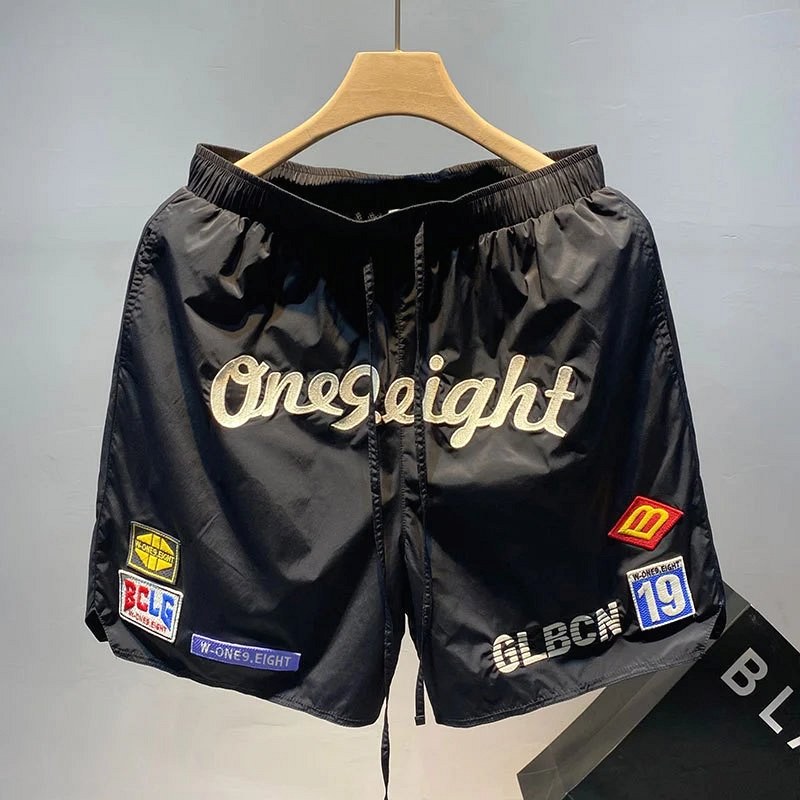
Seven dollars and forty-six cents does not buy much in athletic shorts, so the interesting question is not whether these are excellent shorts. It is whether the listing describes the same garment that arrives. We ordered a pair, logged the checkout-to-door timeline through our agent, photographed the flat-fold, and then sat the delivered shorts next to the seller's own item specifics. That comparison, not the fabric, is where this listing gets complicated.
The seller's spec sheet disagrees with the seller's title
The title and the product page call these Foreign Trade black athletic shorts in sport-casual style, SKU 7720570468, at $7.46 against a struck-through $8.51. The underlying item specifics tell a slightly different story. Read side by side, the listing's own fields conflict on two points that matter to anyone buying for a wardrobe or for resale.
| Field | What the listing says | Why a buyer should care |
|---|---|---|
| Brand | Title: Foreign Trade. Spec sheet: Chenshida | "Foreign Trade" is a sourcing category, not a label. Chenshida is the name in the brand field. |
| Production season | 2025 summer in one field, 2024 summer in another | Two runs may share one listing; ask which stock your size ships from. |
| Colour range | White, black, orange, green | The title names black only. Confirm the colourway in the order comment. |
| Fabric | Polyester, slight stretch | Consistent across title, description and spec sheet. This is the reliable part. |
| Length and leg | Five-point (mid-thigh), straight leg | Described in words only; no flat measurements anywhere on the page. |
| Sizes | M, L, XL, 2XL, 3XL | Five sizes, no size chart, no model height reference. |
What "Foreign Trade" is doing in a product name
In factory-sourced listings, "foreign trade" usually signals goods made for export orders rather than a domestic retail line. It is a description of the supply route, not a brand promise, and the spec sheet's Chenshida entry is the more literal piece of information. That does not make the shorts worse. It does mean the name on the listing is not the name you should expect on a label, and buyers searching for a specific brand should treat the title as a category marker.
The listing is internally consistent about materials and cut, and inconsistent about identity. Those are different kinds of risk, and only the second one can be fixed with a message to the seller.
What the parcel actually contained
Our pair arrived flat-folded in a clear poly bag inside a soft mailer, with no hangtag and no brand card — unremarkable for a factory-source item and consistent with the low price. The shorts matched the listing photographs on the details that are checkable at a glance: black body, straight leg, elastic waistband with a drawstring, script lettering across the front, and the small patch details on the lower legs.
On the bench, three things stood out:
- Fabric hand. The polyester is thin and dry to the touch, with the slight two-way give the listing promises. It is summer-weight, not a fabric that will hide a phone in a pocket or drape like a heavier knit.
- Waistband and drawstring. The elastic channel is wide enough to sit flat rather than roll, and repeated pulls on the cord did not distort the stitching at the exit holes. The cord ends are simple, with no metal tips.
- Seams and patches. We checked the four main seams and found even stitching with no loose thread ends worth trimming. The leg patches are attached, not printed, and sit flat after a cold wash.
Fit without a single published measurement
This is the listing's real weakness. Five sizes are offered, but there is no waist, hip, inseam or leg-opening figure anywhere on the page, and no independent buyer reviews to borrow a fit report from. Our approach was to tape the delivered pair against a reference short we already own and compare the shape rather than trust the label: the waist sits true to the stated size, the rise is mid, and the hem lands above the knee, in line with the five-point description. The straight leg leaves room through the thigh without ballooning.
That is one data point on one body. If you are between sizes, or ordering for someone else, the absence of a size chart is the single biggest reason to message the seller first and ask for flat waist, hip and inseam numbers for the size you intend to buy. Do that before you consolidate a parcel, not after.
Where the $7.46 goes, and where the risk sits
The sticker is only part of the cost. Freight and agent handling typically exceed the item price on a single pair, which is why these shorts make more sense as a filler item inside a larger haul than as a standalone order. At this price the construction is fair: nothing about the stitching or the waistband suggests it will fail early, and nothing suggests it will outlast a $40 pair either.
The risks are documentation risks, not manufacturing risks. No published measurements, no independent wear reports, a brand field that contradicts the title, and two production seasons in the same listing. Each of those is answerable with a short message to the seller before checkout. None of them is answerable afterwards.
How we would order it again
- Ask for flat waist, hip and inseam measurements for your size, and compare them with a pair you already wear.
- State your colourway in the order note, since the title names black while the listing offers four colours.
- Confirm which production season is in stock if the run matters to you.
- Bundle it with other items rather than shipping one pair alone.
As a cheap, plain, mid-thigh polyester short in a street-casual register, it does the job the photographs advertise. As a listing, it asks you to do the measuring yourself.