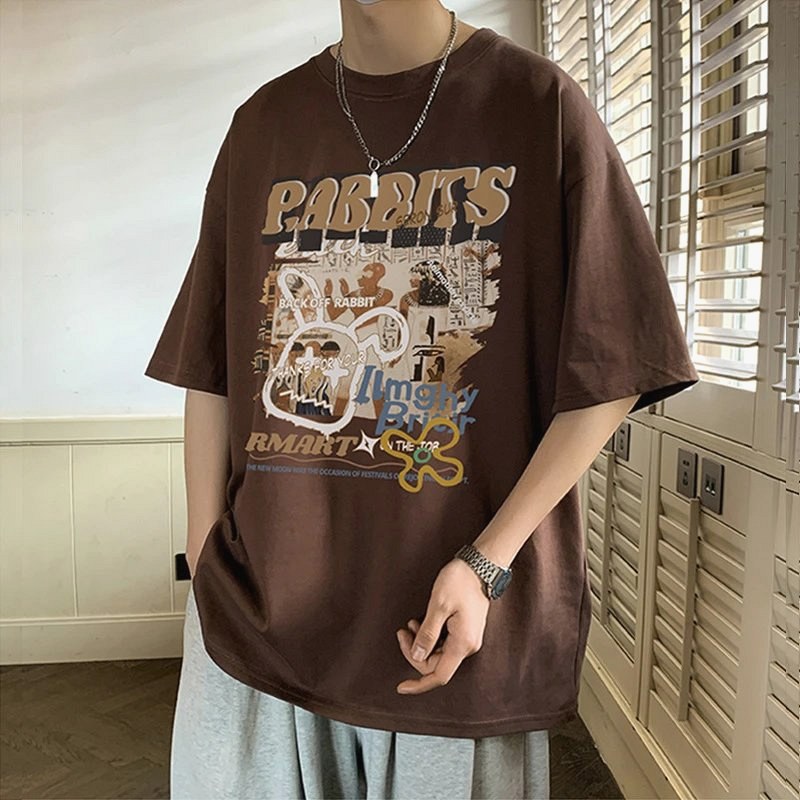
This is the Foreign Trade brown T-shirt in casual streetwear style, SKU 7715824179, listed at $5.97 against a $6.83 original price in seven colorways from S to XXXL. Our testing team ordered two units in size L and wore them through Portland's late-summer heat. The review below concentrates on one thing the listing is unusually specific about: fabric weight.
One spec line carries the whole fabric story
The English product page is mostly adjectives — loose, casual, streetwear. The underlying specification row is where the measurable claims sit, and almost all of them point back to the same number.
| Listing line | What it promises | What we found |
|---|---|---|
| Fabric weight band | 180 g to under 250 g per square metre | 194–201 g/m² across three swatches from two units |
| Main fiber / fabric name | Cotton / pure cotton | Cotton hand, no elastane; no stretch recovery at the neckline |
| Thickness | Normal | Consistent with the measured range — not sheer in coffee brown, not opaque in bright light |
| Measurement tolerance | 1–3 cm | Applied to every flat measurement, including body length |
| Size range | S–XXXL, loose fit | Confirmed as offered; see our separate tape-measure report for the numbers |
A 70-gram spread is not a rounding detail. In t-shirt terms, 180 g/m² is a light summer jersey that drapes softly and can thin toward semi-sheer; 240 g/m² is a substantial midweight that holds a boxy shape and hides what is underneath. The listing is telling you it could be either, and both would be accurate.
How we turned a $5.97 tee into a grams-per-square-metre number
At this price, destructive testing is affordable, so we did it properly. We cut a 10 cm by 10 cm square — 100 cm² — from the inside hem allowance of each of the two delivered units, plus a third from the spare hem on the wider unit. Each swatch came off the flat jersey, away from the print, the rib and any seam. They went onto a 0.01 g bench scale.
- Swatch 1: 1.94 g → 194 g/m²
- Swatch 2: 2.01 g → 201 g/m²
- Swatch 3: 1.99 g → 199 g/m²
Average: 198 g/m². That sits comfortably inside the advertised band and a little above the 180 g floor. It also means the seller is not overselling a thin promotional blank as something heavier — a claim we have caught on cheaper listings.
What the scale cannot tell you is which end of the band the next production lot will land on. Our units came from the same order and agreed to within 7 g/m²; a different run could plausibly sit 40 g away and still match the description.
What 198 g/m² actually feels like
We compared the delivered tee against two reference garments we keep on the bench: a 180 g/m² retail cotton crew and a 240 g/m² blank-style tee used for print tests. The Foreign Trade unit behaved like the 180 g garment at the collar and the 240 g garment at the chest — softer than expected through the shoulders, with more body across the front panel than the light retail crew.
In practical terms, the fabric breathes well enough for a warm afternoon, hangs away from the body instead of clinging, and has enough substance that the large cartoon graphic and lettering do not sit on a visibly textured base. The loose cut does the rest of the work: with the fabric this light, the silhouette reads relaxed rather than structured, which is what the streetwear framing implies.
Why the 70-gram band is the real risk
Everything else about the listing is unusually plain — no exaggerated GSM, no "heavyweight" language, no premium fiber claim. That honesty is worth noting. The exposure is variability, not inflation. If you are buying one shirt to see how the fit works, the band does not matter. If you are buying five for a group or planning to reorder in a different colorway, it does.
Three checks protect you before you commit:
- Ask the agent for a parcel weight with the shirt alone on the scale. A size L should land near 200 g if the fabric is mid-band; 170 g signals the bottom of the range.
- Order one unit first, then reorder from the same listing rather than a lookalike, and keep the item ID in your notes.
- Treat white and apricot as the colorways where a low-band lot would be most visible. Coffee brown, dark gray, dark green and black hide weight differences best — which is an argument for the brown in the title.
Where the tee still leaves you guessing
Three things we could not settle. There is no care label inside the neck, so wash temperature is inference rather than instruction; we used cold cycles and air drying. The listing carries no buyer-reported feedback, so shrinkage, color drift and print wear remain unverified beyond our own two units. And the stated 1–3 cm tolerance means the size chart is a guide, not a specification — measure a shirt you already like and compare it to the chart rather than trusting your usual letter size.
Nothing in our testing contradicts the seller's claims. The weight line is accurate for the units we received, the cotton is cotton, and the loose crew silhouette matches the photos. The caution is simply that the listing's most precise-looking number is also its widest.