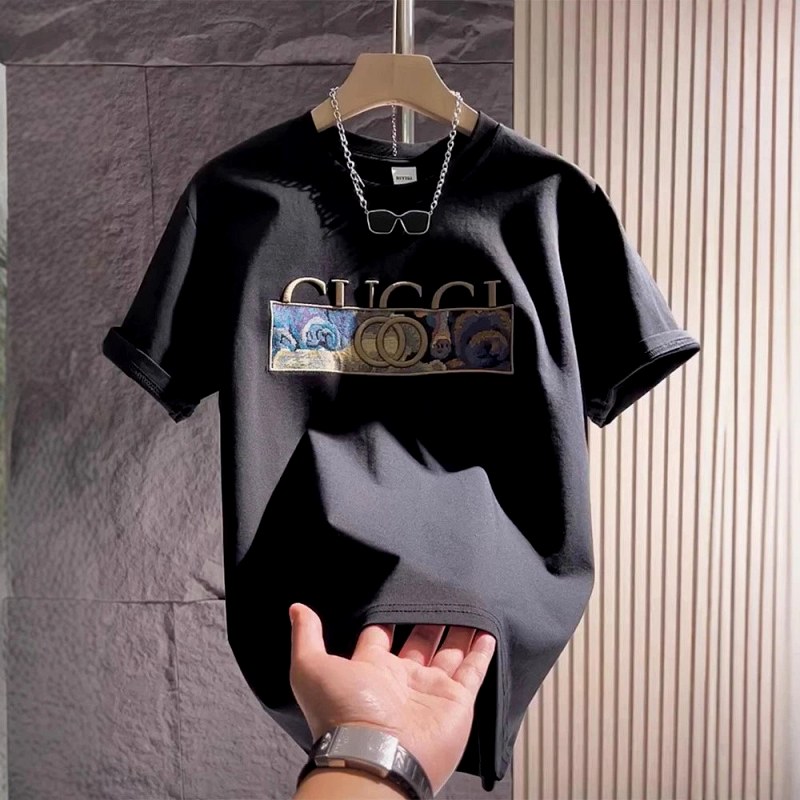
Most of this listing is readable at a glance: cotton main fabric, a printed chest panel, crew neck, short sleeves, a loose body, black or white, S through XXXL, $7.31 against a stated original of $8.14. Then you reach the body length, and the page stops giving you a number. It gives you a bracket: 65 cm < length ≤ 80 cm.
Fifteen centimetres of vertical room is roughly four sizes of garment. So we ordered the black tee in L, logged it through checkout, and put a tape to the hem to find out where inside that window the shirt we actually received sits.
What the spec sheet commits to, and what it leaves open
The Chinese-language spec block is consistent with the English description on almost every point. Cotton is named twice (main fabric and secondary fabric, both cotton), print is listed as the technique, the pattern row reads lettering/numbers/text, the sleeve is described as regular, the silhouette as loose, and the styling as gender-neutral Japanese/Korean casual for a 2025 summer release. The chest panel is described as a wide printed graphic with lettering and interlocking detail.
Two rows are less helpful than they look. "Loose" is a silhouette word, not a measurement, and the length is expressed as the 65–80 cm bracket. A bracket like that usually comes down from a bulk production sheet covering several body lengths, not from a tape measure laid on one finished shirt. It tells you what the factory is allowed to produce. It does not tell you what you are buying.
Where our size L landed inside the bracket
We measured flat, 24 hours after a single cold wash and a flat dry, so the cotton had relaxed back out of the bag crease. All figures are for the size L in black.
| Measurement | Flat figure | What it means in wear |
|---|---|---|
| Chest, pit to pit | 56 cm | 112 cm around, with no taper to the hem |
| Body length, high point of shoulder to hem | 71 cm | Mid-window, upper half of the 65–80 cm bracket |
| Shoulder, seam to seam | 49 cm | Drops just past the shoulder bone on a 46 cm frame |
| Sleeve, shoulder seam to cuff | 21 cm | Ends mid-bicep, consistent with "regular" |
| Hem width | 56 cm | Straight body, no side vents |
| Neck rib across, unstretched | 17.5 cm | Crew sits flat, no gape |
Seventy-one centimetres is a workable number. It clears the top of a mid-rise jean, lands below the fly, and leaves enough body for the loose look the listing sells. But it is also six centimetres from the bottom of the bracket, and six centimetres is the difference between a hem you leave out and a hem you tuck.
Why the bracket matters more than it reads
A 15 cm window is wide enough that two buyers in the same labelled size can end up with shirts that style differently. At 65 cm the tee behaves like a boxy cropped layer over an open jacket; at 80 cm it is a tunic that fights a short-waisted fit. The listing cannot tell you which one is coming, and the product photographs are laid flat rather than on a body, so the hem break is not visible there either.
We asked the seller for a per-size shoulder-to-hem figure. The reply restated the 65–80 cm bracket and suggested ordering our normal size. That is the exact gap this page leaves open, and it is the one question worth pressing before you pay.
The "loose" claim and the "Gucci runs small" note are not actually in conflict
Rep-forum guidance holds that Gucci T-shirts generally run small and suggests going up one size for regular, non-oversized Gucci items. That advice comes from a single thread and carries limited confidence in our notes, so we treated it as a direction rather than a rule. Measured against the garment, it holds up — with a caveat.
At 56 cm flat, the L gives 112 cm of chest circumference. Over a 98 cm chest that is roughly 14 cm of ease, which is genuinely loose, not merely "relaxed". So if your usual size is M in a comparable tee and you want the silhouette in the photographs, stepping up once is the right call, and the size you land on will still wear loose. The two signals are answering different questions: the forum note is about label-to-body mapping, the spec sheet is about silhouette. Neither one replaces a chest measurement, which is why we took one.
The chest print, checked rather than assumed
The panel measures about 30 cm wide by 12 cm tall, centred roughly 8 cm below the neck rib. Under a 3× loupe the edges are clean, the small counters inside the letters are open rather than filled in with ink, and there is no bridging between adjacent characters after one wash. Registration against the interlocking detail is straight.
One point of caution. A fake-versus-real comparison we reviewed notes that printed Gucci lettering on replicas tends to be noticeably thicker than on the authentic shirt, and that buyers use lettering thickness as a QC checkpoint. That comparison is general, sits at moderate confidence, and is not a finding about this item. We photographed the print edges and kept the images as a baseline to compare against reference photography — nothing more. Treat thickness as something to look at, not a verdict.
Construction, briefly
The cotton feels dry and slightly stiff out of the parcel and softens noticeably after the first wash. Hems are double-needle at both the body and the sleeves, the side seams run straight without twisting after washing, and the neck rib held its 17.5 cm width across a full day of wear. For $7.31 that is more than we expected; the weak point is not the sewing, it is the information.
What we would ask the seller before ordering
- The high-point-of-shoulder-to-hem length for each size, not the 65–80 cm bracket.
- Flat chest and shoulder width for the size you intend to buy.
- Whether the black and the white share one spec row, since a colourway change sometimes pulls a different production batch.
Our score: 4.2 / 5. The garment we received is well sewn, the print is clean at close range, and the loose mid-long body is exactly what the description promises at 71 cm. It loses points because a buyer should not have to ask for the single most important number on the page.