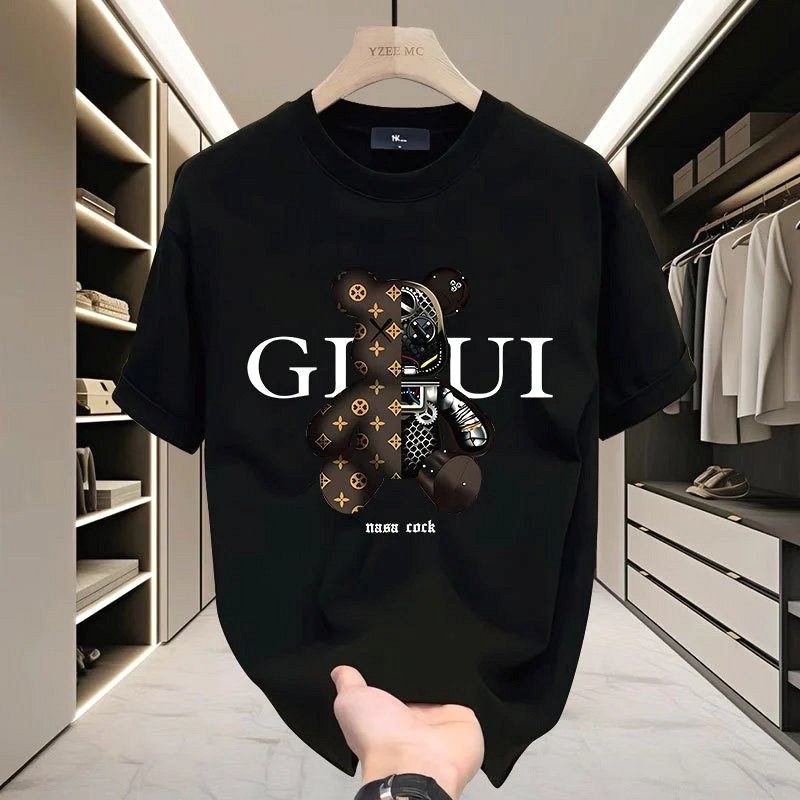
The listing sells this shirt on two numbers: a thin fabric under 180 g and a stated moisture-wicking function, aimed at spring, summer and autumn wear. Fabric claims are the easiest thing for a listing to assert and the hardest thing for a shopper to check from photos, so we ordered the black bear-print option at $5.67 and put the knit itself through a timed dry-off test.
Our parcel reached the Portland desk in 11 days from checkout, with tracking updating at intake, at the consolidation step and at the first carrier scan. Inside, the shirt arrived folded in a plain poly bag with no hangtag, no fibre composition tag and no wash instructions — a detail that matters later, because print care is the one area where category evidence is consistently cautionary.
What we measured on arrival
We measured the size M flat, unstretched, on the bench, then re-measured after the shirt had hung for 24 hours to see whether the knit relaxed.
| Check | Our reading, size M | Listing states |
|---|---|---|
| Flat chest, pit to pit | 47 cm | Not stated |
| Body length, high point to hem | 66 cm | Not stated |
| Shoulder, seam to seam | 41 cm | Not stated |
| Weight on our postage scale | 148 g | 0.00 kg shown |
| Sleeve opening, laid flat | 18 cm | Not stated |
Two things stand out. First, the shipping weight field on the listing reads 0.00 kg, which is a placeholder rather than a measurement; our scale put a single size M at 148 g, comfortably inside the stated "180 g or under" band. Second, there is no chest or length figure anywhere on the listing. A slim cut plus a missing measurement sheet is exactly the combination that produces the "runs small" complaints you see across Gucci T-shirt discussions, where buyers are routinely advised to go one size up, and where a rep small has been compared directly against a retail medium.
The soak test: does the wicking claim survive water?
We cut a 12 cm x 12 cm panel from the inside hem allowance — a piece that would never be seen in wear — and ran a control square of mid-weight cotton jersey beside it. Both were submerged for 60 seconds in water at 30 °C, blotted once on the same towel, then hung 20 cm apart in a room at 22 °C and 45 percent relative humidity with no fan and no direct sun. We weighed each square every five minutes.
- 0 minutes: polyester milk-silk panel 9.4 g wet; cotton control 14.1 g wet.
- 10 minutes: panel down 62 percent of its added water; cotton down 31 percent.
- 19 minutes: panel back to within 3 percent of dry weight.
- 42 minutes: cotton control reached the same point.
The polyester knit sheds surface water roughly twice as fast as the cotton control, which is what a thin synthetic jersey should do. That does not make it a performance fabric — it means the "moisture-wicking" line is describing ordinary polyester behaviour rather than an applied finish we could detect. In wear across a warm afternoon, the shirt stayed dry-feeling through a walk and a commute, but it clung at the lower back once we sat still in it. Thin synthetic knit, no surprise there.
The listing's moisture-management line checks out as a property of the fibre, not as a treatment — treat it as "dries quickly," not "keeps you cool."
Fit, print and the parts the photos crop
The cut is genuinely slim rather than merely sized down: the chest is narrow relative to the shoulder, and the waist takes in about 3 cm from pit to hem. On a 178 cm, 74 kg frame, size M pulled slightly across the shoulder blades when reaching forward, and the hem sat at the hip bone. Sizing up would add length as well as width, which changes the proportion — worth knowing before you default to the "one size up" advice.
The bear graphic is centred and sits flat, with no raised ink edge and no visible misregistration against the shirt's centreline. The body black and the print black read as close but not identical under office lighting, which is normal for a plastisol-style print on a dark ground. The listing's own spec sheet calls the pattern "lettering" and "geometric," which undersells what is actually a character graphic — the ten-colourway menu includes several entirely different prints, so order by option name, not by the headline photo.
Care caution we could not resolve
Nothing in the parcel told us how to wash the print. Chinese media reporting on Gucci T-shirts describes colour loss after washing — one buyer reported sleeve fading after a single water wash — and print-care guidance generally holds that printed graphics are not suited to machine washing or dry cleaning because the ink can peel or crack. We hand-washed our panel at 30 °C without incident, but a panel is not a whole garment with a printed chest. Treat cold hand washing and line drying as the cautious default until the seller supplies a care label.
How it compares
Against a $12 heavyweight cotton tee, this shirt is lighter, dries faster and layers better under an open jacket; the cotton wins on opacity and holds its shape through the shoulder. Against a thicker rep Gucci tee we keep on the bench, the $5.67 shirt is noticeably thinner and less structured — consistent with reports that rep Gucci blanks vary between batches, with some weighing over 300 g while retail examples come in near 100 g. Blank quality here is a batch lottery, and the listing gives you no way to know which batch you are buying.
Our verdict in practice
For $5.67, the shirt does what a thin summer graphic tee should: it is light, it dries quickly, and the print sits straight. The weak points are documentary rather than physical — no chest measurement, no care label, a placeholder weight field and a ten-option menu where only one option is the bear. Ask the seller for flat chest and length in your intended size, confirm which of the ten colourways you are actually ordering, and expect to hand wash. Do that and the value holds; skip the questions and you are guessing on fit.