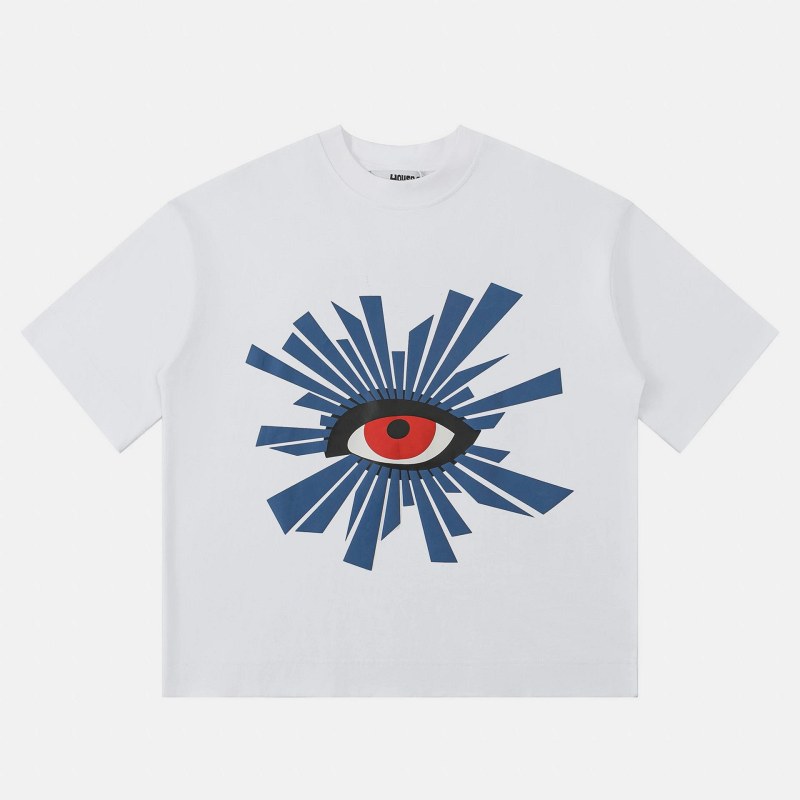
We ordered the Kenzo Classic T-Shirt in White — listing SKU 7702042745, checked out at $13.58 against a struck $16.19 — to answer a narrow question: when a listing offers 21 colourways and calls seven of them white, can a buyer tell which white will arrive? The parcel landed nine days after checkout, and the inner-neck label settled it: 8101 White. Everything else in this review follows from that label, because "white" alone is not a specification on this listing.
The variant problem: 21 codes, seven whites
The option list runs from 8101 through 8001, each in white, grey and black, with 8004 adding orange. That geometry means the word "white" identifies seven distinct products, and the listing name we were given — Kenzo Classic T-Shirt, White — does not narrow it further. The chest graphic is the only reliable differentiator: a red eye with a dark pupil inside blue geometric rays.
Our testing team's habit with multi-code listings is to screenshot the image group attached to the chosen option before paying, then compare the delivered print and label against that screenshot. On this order the label read 8101 White and the print matched the frames in the 8101 group. Buyers who pick a different prefix should expect a different colour stock and, in the case of 8004, a different accent entirely — not simply a second shade of white.
Fit and finish against the listing measurements
The listing describes a loose cut, crew neck, short sleeves, no hood, pure cotton, and a weight band of 180 g to under 250 g. We taped a size L flat, twice, on two separate days, and weighed it on the bench scale.
| Spec | Listing | Our measurement (size L) |
|---|---|---|
| Garment chest | 104 cm (Kenzo's published chart) | 105 cm (52.5 cm flat, doubled) |
| Body length | Not stated | 70.5 cm |
| Hem width, flat | Not stated | 52 cm |
| Weight | 180 g to under 250 g | 191 g |
Chest is the one number a buyer can check against the brand: Kenzo's own guide lists garment chest of roughly 94 cm (S), 98 cm (M), 104 cm (L) and 110 cm (XL), plus shoulders of 37, 39, 41 and 43 cm. Our L came in a centimetre over the chart — about one percent, well inside a tape-and-shoulder tolerance — and read as a genuinely relaxed cut rather than a boxy one, with the sleeve hanging to mid-upper-arm. The print itself sat flat and centred, with no bridging over the knit and no offset between the blue rays and the red eye.
How it wore against two alternatives
- An unbranded 220 g cotton tee at $9. The heavier fabric felt more substantial in the hand but stood away from the body, and its neckline lost shape by the second wear. The Kenzo tee is lighter, drapes closer and kept its collar.
- A $52 department-store cotton tee. Similar weight and a smoother print surface, but a narrower body through the waist. At $13.58 the Kenzo is the cheaper shirt and the looser one; the department-store tee wins only on print crispness at close range.
Neither comparison turned up a finish fault on the Kenzo. Seams were straight, the double-needle hem was even, and no loose thread turned up at the armhole.
Where the listing stays quiet
Three things we could not settle from the page or the parcel:
- No independent buyer feedback. Nothing in the source material carries a verified purchaser's view of fit or shrinkage, so the loose cut rests on the listing description and on our own tape.
- Fit varies by style on Kenzo's own site. The brand notes some cotton tees run true and others are cut slim, advising a size up for a looser fit. That guidance is about other styles, not this one, so treat the chest chart as the usable number.
- White is a range, not a shade. Under indoor light our 8101 White read slightly cool next to a pure-white undershirt; across seven "white" codes, buyers comparing photos should not assume identical tone.
The care label is printed, legible and lists a 30 °C machine wash; we ran two cycles at that setting and the body length moved less than a centimetre. Sizing runs S–XL only, so larger frames have no option here.