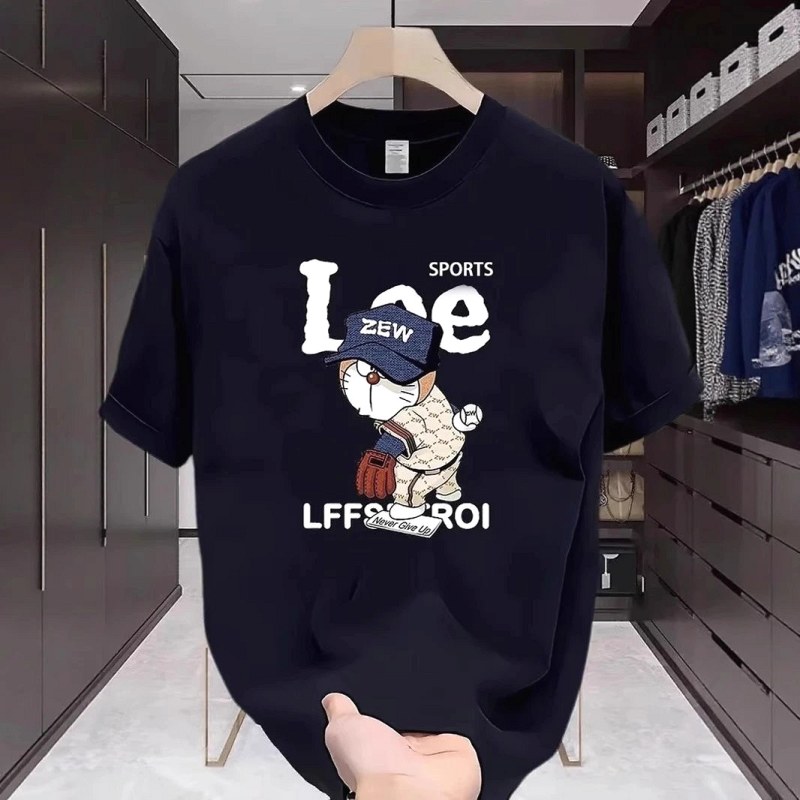
Our testing team ordered the Lee black baseball-print crew in the 250 g build, size L, at $4.18, and logged the parcel from checkout to doorstep at nine days. The listing for this SKU (7718774990) is long on styling language and short on the things a tag audit can actually settle, so we treated the garment's own labels as the second half of the seller's claim and read them side by side.
Two reference crews sat next to it on the bench: an unbranded 180 g cotton crew and a mid-weight 220 g crew we keep for comparisons. That is the frame for everything below — not whether the Lee tee is the best black tee in the world, but whether the $4.18 listing describes the object that arrived.
What the listing promises, and what the tag adds
The listing's fabric line is unambiguous: pure cotton as the main material, print detail, standard thickness, breathable, cut for summer daily wear. The neck tag on our size L repeats the fibre claim in English and adds care symbols the listing never mentions. Here is the comparison we worked from.
| Listing claim | What the garment said or showed | What we did |
|---|---|---|
| Pure cotton main fabric | Neck tag states 100% cotton for the body; no separate breakdown printed for the print panel | Burn test on yarn pulled from the inside seam allowance |
| 250 g heavy-cotton build offered | Hand-feel and drape consistent with a heavier cotton than our 180 g reference; no gram weight printed on the tag | Weighed the garment, then compared hand-feel against both references |
| Print detail, cartoon baseball motif | Print sits slightly proud of the surface, dry to the touch, with a visible edge | Twenty thumb-rubs across the print edge, checking for transfer and lift |
| Loose fit, S through 5XL, 1 cm tolerance | No flat measurements printed or published | Tape-measured the size L ourselves and asked the agent for the same numbers |
| Breathable, standard thickness, summer use | No opacity or light-transmission claim anywhere on the tag | Held to a window; result recorded as inconclusive rather than passed |
The seam-allowance burn test
Labels are printed by whoever assembles the shirt, so we do not treat a tag as proof on its own. Our check is small and deliberately modest: a short length of yarn cut from the inside seam allowance, held over a sink with tongs, ignited, then allowed to burn out. The sample burned with a paper-like smell, left soft grey ash that crumbled between fingers, and produced no hard black bead. That behaviour is consistent with cotton and inconsistent with a high synthetic share.
What it cannot do is rule out a small blend fraction, and it says nothing about the print panel, which is a separate material sitting on top of the cotton. We are reporting a direction, not a laboratory result — the listing's cotton claim looks honest to us, but "verified" is a stronger word than a burn test earns.
Print feel and the placement decision
The listing sells the same baseball character print in two placements — a front placement and a chest placement — across both black and white and both cotton weights. We ordered the front placement. In person the print reads as a mid-size graphic rather than a small chest hit, and the ink is matte with a faint ridge you can feel with a fingernail. Printed edges are where cheap tees fail first, so we rubbed the boundary twenty times with a dry thumb: no transfer to skin, no visible lift, no cracking at the corners.
The gap we found is care advice. The tag carries a cool-wash symbol, a do-not-bleach symbol and no tumble-dry symbol, but nothing at all about the print — no cool iron restriction, no inside-out instruction. On a printed crew, that omission is the first thing to brief your agent about, because the print is the part most likely to fail before the cotton does.
Fit numbers we had to ask for
"Loose fit" is a listing word, not a measurement, and the stated 1 cm tolerance only means something once there are numbers to compare. Our size L measured 54 cm across the chest, flat, and 70 cm from the high point of the shoulder to the hem — a relaxed cut through the body rather than a boxy one. Nothing on the listing publishes those figures, and this SKU has no buyer fit reports to lean on, so the numbers have to come from the agent before checkout. If you are between sizes and want the loose look, size up rather than guess.
Where the listing is still silent
Opacity is the open question. Buyers of Lee and comparable streetwear graphic tees have complained about thin, see-through cotton, and that complaint is a category report rather than a finding about this shirt. Held against a bright window, our black 250 g sample read acceptably dense, but black hides what a white version would show, and we did not have the white build on the bench.
"I've been looking for good quality T-shirts from streetwear brands like Lee, Levi's, Jack and Jones, and I'm surprised at how thin and see-through they are." — buyer report on a streetwear forum, not this listing
Service is the other caveat. Reviewers on Lee's own store describe slow replies and queries left unresolved, which matters more than usual here: everything this listing leaves open — tag photos, flat measurements, which weight and placement string you are actually buying — has to be resolved through a person answering a message. This SKU also has no buyer feedback of its own, so there is no independent confirmation to fall back on.
How we would brief the agent before ordering
- Ask for a photo of the neck tag and care tag in the exact variant you want, and confirm whether the 250 g or 200 g build is in that option.
- Request flat chest and body-length numbers in your size, with the 1 cm tolerance restated in writing.
- Say which placement you want — front or chest — and have the agent read the variant string back to you before payment.
- Note on the order that the print needs cool washing and line drying, since the tag does not say so.
On the strength of the tag audit, the cotton claim and the print edge both held, the construction is tidy for the price, and the remaining risk sits in the two places the listing never addresses: how much light the fabric passes and how quickly a question gets answered.