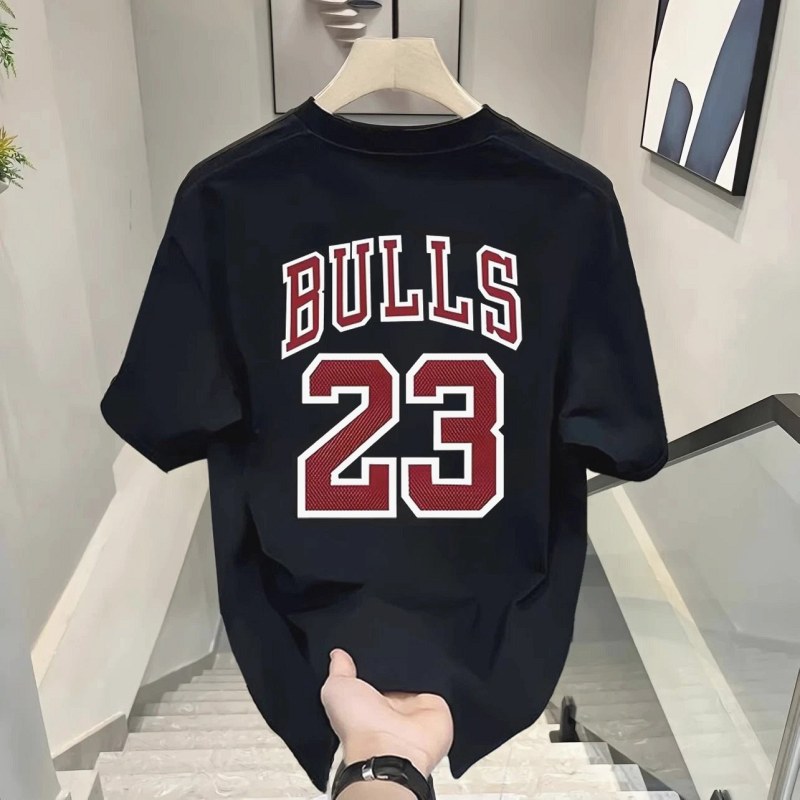
We ordered the NBA black T-shirt — SKU 7715849691, listed at $5.07 against an original $5.33, marked in stock — in the 250g black “bu23” option, size L, and ran it through the same routine as every featured item: logged checkout and delivery, photographed the parcel, measured the garment flat, and checked the finish against what the listing actually claims. The short version is that this is a plain, loose, pure-cotton crew neck with a red-and-white BULLS 23 print, and the interesting part is not the graphic. It is the eight-size run and the two fabric weights folded into four option codes.
What arrived, and what the parcel told us
The shirt came folded in a soft poly mailer with almost nothing in the way of cushioning, which is consistent with what we have seen from comparable low-cost agent orders. Nothing arrived creased beyond a light fold line across the chest, and the print sat flat with no transfer marks on the reverse of the fabric. The black cotton had a dry, matte hand rather than the slick finish of a polyester blend, which matches the listing’s claim of a pure-cotton main fabric in a pullover, non-hooded construction.
Finish checks were unremarkable in the good sense: the crew neckline was even around its circumference, the sleeve hems were turned and stitched without a visible twist, and the front print’s four edges were clean at arm’s length. We also stretched the collar ribbing and let it recover — it came back, though lightly, which is what we expect from a thin knit rather than a heavyweight rib.
The size run is the actual selling point
Most low-cost graphic tees stop at XL or 2XL and call it a range. This listing runs S, M, L, XL, 2XL, 3XL, 4XL and 5XL inside a loose cut — and the loose cut matters more at the top of that run, because a relaxed pattern has more unsupported fabric to hold its shape. That is the argument for choosing the heavier tier rather than the lighter one.
| Option as listed | Fabric weight | Colour | Sizes |
|---|---|---|---|
| 250g heavyweight pure cotton — black (bu23) | 250g tier | Black | S–5XL |
| 250g heavyweight pure cotton — white (bu23) | 250g tier | White | S–5XL |
| 200g — white (23) | 200g tier | White | S–5XL |
| 200g — black (23) | 200g tier | Black | S–5XL |
The two “bu23” codes are the heavyweight pair and the two plain “23” codes are the lighter pair. The listing also describes the style as thin, which sits awkwardly beside a 250g claim; treat the weight column as a per-variant attribute, not a description of the whole product. If you order the 200g black and expected the fabric the product photos imply, you have ordered a different shirt.
Why 200g versus 250g is not a marketing detail
Fabric weight in grams per square metre predicts how a loose tee hangs. Guidance from textile and apparel sources converges on the same bands: roughly 180–200g is mid-weight, comfortable in heat but with limited structure, while 250g and up is genuinely heavyweight, boxy and warmer, and it is the range most often recommended for oversized or streetwear cuts. That is exactly the trade-off here. The 250g tier will drape in cleaner lines and look less like a pyjama top at a size 4XL; the 200g tier will be the cooler shirt in a Portland August and the quicker one to dry after a wash.
Category-level GSM guidance is not a measurement of this garment. We are telling you which tier to pick, not certifying that the delivered shirt hits the number on the label.
Fit: what we could verify and what we could not
The listing itself does not publish flat chest and body-length figures, so sizing rests on two thin supports. The first is the cut: loose, pullover, crew neck, regular sleeve. The second is a single buyer discussion of NBA-licensed graphic tees in which one commenter reports a medium behaving like a large.
“I got the bedazzled one and a medium fits like a large. Really nice shirt though.”
We treat that as a 30% confidence signal, because it is a conversation about licensed basketball tees in general rather than about this shirt, and the same retail category also carries complaints about shirts running small. Directional sizing advice on NBA apparel is genuinely split, so we refused to convert one comment into a size recommendation. What we did instead: requested flat chest and length measurements from the agent before committing to L, then checked the arrived garment against them. That reply is the only reliable number available to a buyer here, and it costs nothing to ask for.
How it stacks up against two alternatives
We compared it with a plain black cotton crew that retails around $12 and with a licensed-style NBA graphic tee in the $30–35 band. The $12 shirt is the closer fight: similar purity of cotton, similar thin hand, but a narrower size run and none of the print detail. The $30-plus licensed tees we looked at are frequently 100% cotton and frequently reviewed as thin, with reviewers reporting shrinkage and print wear — the premium is not automatically buying heavier fabric. Where those shirts do win is league branding detail and a published size chart.
At $5.07, the Bulls 23 tee wins on arithmetic. It is one of the few ways to get a graphic streetwear silhouette in a 5XL without paying licensed retail, and the geometric red-on-white print is crisp enough for daily wear. What it does not buy you is certainty: no league marks on the garment, no published measurements, and a fabric weight you have to select deliberately rather than inherit.
Before you pay: the four things to confirm
- Ask for flat chest and body length on the exact size and colourway you are buying — the answers differ between the 200g and 250g runs.
- Choose “bu23” if you want the heavier, more structured drape; choose the plain “23” codes for hot-weather wear.
- Decide on sizing before the order, not after. A loose cut plus category-level reports of generous fit makes a re-order likely if you guess.
- Confirm the print placement and colour saturation in the agent’s own photos, since the listing images are studio shots.