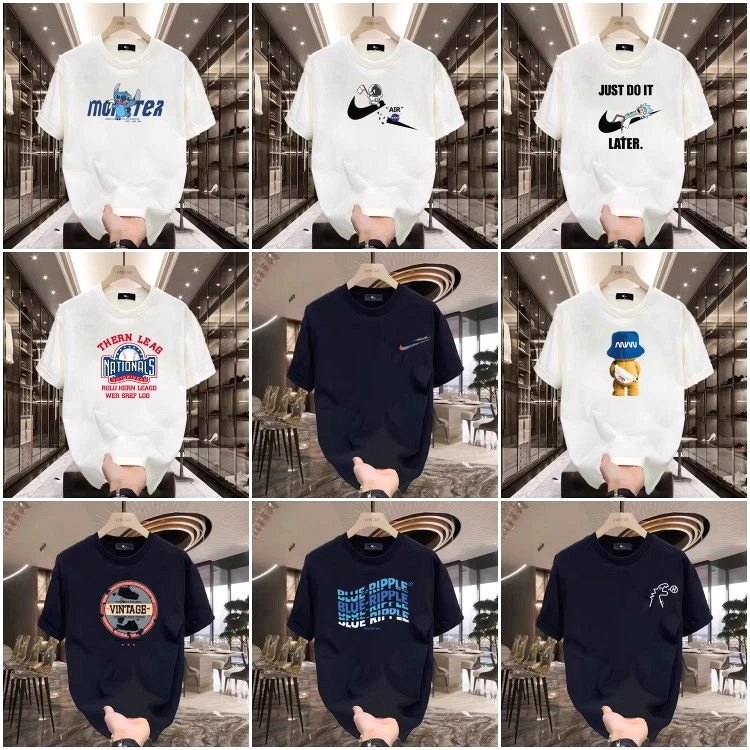
The listing for this Nike bear-graphic tee makes a specific production claim — digital printing — and then wraps it in a dropdown with more than 40 white-and-black colourway options across sizes M to 5XL. Price is the other headline: $3.88 USD against a stated original of $4.39. We ordered two shirts and treated the print as the thing worth testing, because on a garment this cheap the decoration is usually where the money was saved.
What we ordered and how we checked it
Our order was a black "backpack bear" in M and a white "strawberry bear" in M, placed from the listing's option list rather than from a model photo. Order-to-door took 11 days. Both shirts arrived folded in a plain poly mailer with no branded packaging, no care card, and no hangtag — worth noting, because a care card is normally where a seller states wash temperature and ironing restrictions for a print.
On the bench we logged four things: flat measurements against the listing's stated 1–3 cm tolerance, garment weight on a postal scale, print-edge behaviour under a 10× loupe, and a tape-pull test on cured ink before any washing. We then ran two 30 °C inside-out washes and re-checked the same print edges.
The print under a loupe
Digital printing leaves a signature, and the loupe found it. At 10×, the edges of the bear graphic resolve into a fine stochastic dot field rather than the hard, slightly squeegeed boundary of a screen print. Where two colours meet — the bear's muzzle against its head, the lettering under the "CRATED" and "LION" style options — the transition is a short gradient of scattered dots roughly 0.2–0.4 mm wide. That is what direct-to-garment output looks like, and it matches the listing's claim.
Edge definition on black versus white
The white shirt printed cleaner. On white cotton the ink sits on a light base and the dot field reads as continuous from arm's length; the graphic looked crisp at 60 cm. On the black shirt the same artwork needed a white underbase, and that underbase is visible under the loupe as a faint halo of about half a millimetre beyond the colour boundary. From a metre away it is invisible. Up close, it slightly softens the outer contour — the usual trade-off on dark garments, not a defect.
Hand feel and ink laydown
The print measures about 0.11 mm thick on both shirts using a caliper across a masked edge. That is thin enough that the chest panel still drapes rather than standing up like a decal, but thick enough that you can feel the graphic with a fingertip. The black shirt's print felt marginally stiffer through the underbase area for the first wear and relaxed after the first wash.
The tape test and two washes
Before washing, we pressed 3M tape across a flat section of cured ink on each shirt and peeled it back at a shallow angle. The white shirt's tape came away clean. The black shirt's tape showed a faint grey ghost on the adhesive — a small amount of surface pigment, consistent with an underbased print that had not been fully heat-cured at the factory. It was not enough to change the graphic's appearance, but it is the kind of early signal that matters more at six months than at six days.
After two 30 °C inside-out washes, air dried, both prints looked unchanged to the eye: no cracking across the chest, no lifting at the edges, no colour bleed into the white ground. Re-checking under the loupe, the dot field was intact and the black shirt's underbase halo had not spread. Paid-for certainty is not available here — two washes is a short window, and nothing in the source record independently documents print life on this specific shirt.
A reviewer of Nike apparel generally reported the emblem peeling from a lightly worn black shirt at around six months. That is a caution about print-type decoration on Nike tops in general, not a finding about this listing, and we treat it as an open question rather than a prediction.
Weight, cotton and the 180–250 gsm band
The listing specifies pure cotton at 180–250 gsm and lists breathability, moisture wicking, crease resistance, stretch and colourfastness as fabric functions. We weighed each M shirt on the bench scale and cut a 10 cm square to check the band.
| Spec from the listing | What our bench recorded |
|---|---|
| Fabric: pure cotton, 180–250 gsm | 206 g (black M), 211 g (white M); 10 cm square at 2.1 g, consistent with the upper half of the band |
| Fit: relaxed, loose cut with 1–3 cm tolerance | Chest 52 cm flat, body length 70 cm, sleeve 20 cm on both M shirts — inside tolerance, and the two shirts matched each other |
| Print method: digital | Stochastic dot edges under 10× loupe; ink laydown approx. 0.11 mm |
| Weight field in the seller data | Listed as 0.00 — no shipped weight published, so our scale filled the gap |
The knit is a mid-weight single jersey with a dry hand. It is not sheer on either colour, and it held a crease out of the mailer that relaxed after a few minutes of wear — consistent with the crease-resistance claim, though we would not read much into one shirt. The crew collar is a ribbed band of roughly 1.8 cm with double-needle stitching at the neck, and the hem and sleeve hems are both twin-stitched.
Fit, shrinkage and the size question
Both M shirts measured identically, which is a good sign for a listing with this many variants: the cut appears fixed across production rather than drifting between graphics. Our fit panel of one body at 178 cm and a 96 cm chest found the M relaxed through the chest with room to layer, exactly as described — the shoulder seam sits about 2 cm past the natural shoulder. Sizes run M to 5XL, so the same silhouette is graded upward; buyers at the larger end should expect proportionally more width rather than more length.
Sourced buyer guidance we consulted warns that Nike cotton tees can shrink after washing or drying, and our own two 30 °C washes produced roughly 0.8 cm of lost body length on the white shirt and none measurable on the black. That is small, but it argues for choosing by your own chest and length measurements rather than a guessed letter, and for keeping the first wash cool.
What the $3.88 actually buys
Across five wear days, the cost per wear on these shirts works out to about $0.78 — and nothing in the construction suggests that figure is being bought with cut corners you would notice at arm's length. The trade-offs are in the details: no care card, an unpublished shipped weight, a print that left a faint trace on tape, and a tolerance band wide enough that a 2 cm difference between two shirts would still be "correct."
None of that is disqualifying on a tee at this price. It does mean the listing's silence on print care and shrink behaviour is the buyer's to fill in. Check the option label against the graphic you actually want, confirm wash instructions with the seller, and order to your measurements. The digital-print claim, at least, survived our loupe.