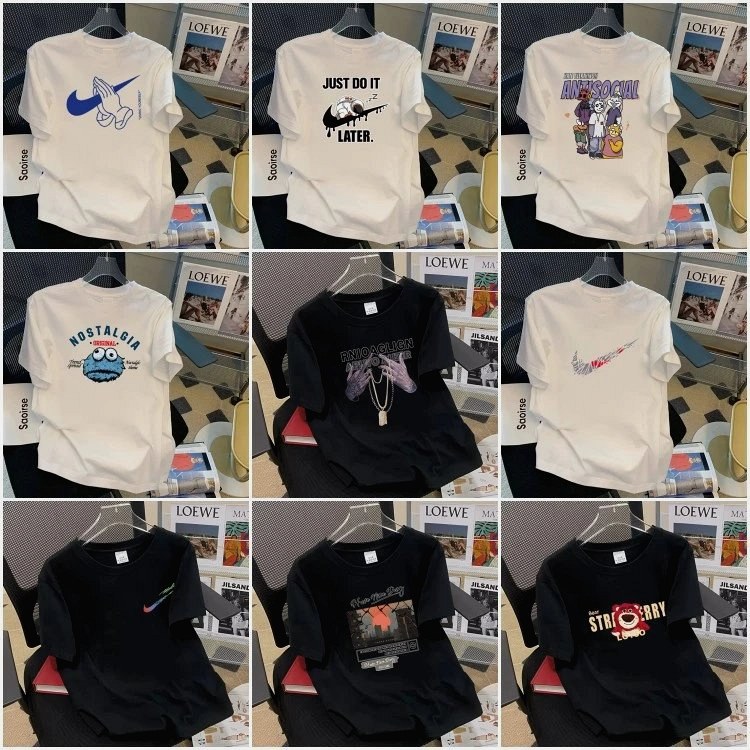
There are thirty ways to buy this shirt. Fifteen cartoon and swoosh prints, each offered as a white or black short-sleeve tee, sizes L through 5XL, listed at $3.88 against a $4.49 original. We ordered three of them — a white and a black in size L, plus a black 3XL — and treated the listing page as the claim sheet it is. What follows is what a postage scale, a tape measure and a week of wear could actually establish, and where the listing left us guessing.
The claims, side by side with what arrived
The product is listed under SKU 7715836021 and marked in stock at the time of ordering. The listing's own specification block is unusually detailed for this price band, which is exactly why the gaps stand out.
| Spec | What the listing says | What we measured |
|---|---|---|
| Price | $3.88 USD, reduced from $4.49 | Charged at the listed price; shipping is a separate line and matters more than the shirt |
| Sizes | L, XL, 2XL, 3XL, 4XL, 5XL | Size ladder confirmed; no medium offered at all |
| Fit | Loose, 1–3 cm measurement tolerance | Chest and length inside that tolerance; the cut is genuinely roomy |
| Fabric | Acrylic named as main component; polyester named as the fabric | Unresolved — see below |
| Weight | 180 g to under 250 g | Size L white 158 g, size L black 166 g, 3XL black 212 g (whole garment) |
| Decoration | Digital print, cartoon and geometric motifs | Sharp edges, thin ink film, no cracking at first inspection |
| Use case | Sports, summer and year-round, breathable, moisture-wicking, colorfast | Dries fast; wicking and colorfastness only partly verifiable in our setup |
Why the 180–250 g figure is close to useless
That range is a fabric weight per square metre, not the weight of the shirt — and a 70-gram spread is not a specification, it is a shrug. It covers the difference between a thin summer jersey and a fabric with real body. A shopper reading "180 g to under 250 g" cannot know which one they are buying, and thirty variants in two colourways are unlikely to sit at a single point inside that band.
Our three tees landed at the light end. On a postage scale the size L white came in at 158 g, the size L black at 166 g, and the 3XL black at 212 g. Converting garment weight back to fabric weight needs the pattern area, so we will not pretend to a precise figure, but the hand-feel and opacity agree with the lighter end of the range rather than the heavier one. The white tee reads slightly shaded under a bright window; the black does not.
The print, up close
Digital printing on a synthetic knit is a reasonable pairing at this price, and the output is cleaner than we expected. Edges on the small swoosh and the cartoon motifs are crisp rather than fuzzy, the ink sits thin enough that the fabric still moves, and there is no visible halo or misregistration between colours. Two cold washes inside out, hang-dried, left the prints intact with a slight softening of the black areas. We are not calling that colourfastness proven — the listing's own claim deserves a longer run than two washes.
Listing text, translated: "Main fabric component: acrylic. Fabric name: polyester (polyester fibre)." Two answers to one question, in the same spec block.
The fiber question we could not close
Acrylic and polyester are not interchangeable, and the listing names both. Independent textile references put acrylic at roughly 1.5–2.5 percent moisture regain against polyester's sub-0.4 percent, with acrylic the softer, warmer, more pill-prone of the two and polyester the stronger and faster-drying. Blended acrylic-polyester knits can test high for air permeability, so the "breathable" claim is not implausible — but which fibre dominates changes how the shirt wears, how it pills, and how it takes heat in a dryer.
In the hand, all three tees feel like a brushed synthetic jersey: smooth, faintly cool, with a little loft. That is consistent with either fibre and settles nothing. If composition matters to you — sensitivity, microplastic concerns, drying habits — ask the seller for the care label before ordering. We could not, and we are not going to guess.
Fit, and the missing medium
The size ladder starts at L. That is a real constraint, not a quirk: a standard-fit medium wearer has no entry point here, and the loose cut makes the L a generous starting size. On a 178 cm, 74 kg frame the L gave roughly 55 cm pit-to-pit and 70 cm body length, with room through the chest and a hem that sits at the hip. A 3XL on a broader build measured about 62 cm pit-to-pit and draped rather than clung. The 1–3 cm tolerance the listing states held for both.
Category-level Nike sizing guidance is consistent with what we felt: tees labelled loose fit run roomy, and shoppers who want a standard fit routinely size down. Our advice is the same as always — get the flat measurements for the exact variant, not the size letter.
Price, and what $3.88 actually buys
At $3.88 the shirt is close to disposable, and it does not feel disposable. Seams are straight, the collar ribbing is even, the hem is level, and the print is competent. What the sticker price does not include is delivery, and on a single-unit order the shipping line can exceed the item. Ordering three at once is how this listing makes economic sense.
Two things temper the value. The first is the fabric ambiguity above. The second is the weight spread: if you receive a shirt at the light end, as we did, you have a fine summer layer and a poor standalone tee in cool weather. Neither issue is fatal at this price, but both are the kind of thing a listing should not leave you to discover.
How we tested it
We ordered three variants through the listing, logged the order-to-door window, photographed the packaging on arrival, weighed each garment, taped the flat chest and body length, inspected print edges under daylight and a desk lamp, and wore the size L through five days of desk and commute use before two cold washes. Sizing evidence from other buyers is category-level and does not describe this listing; we have flagged it as such rather than folding it into our measurements.