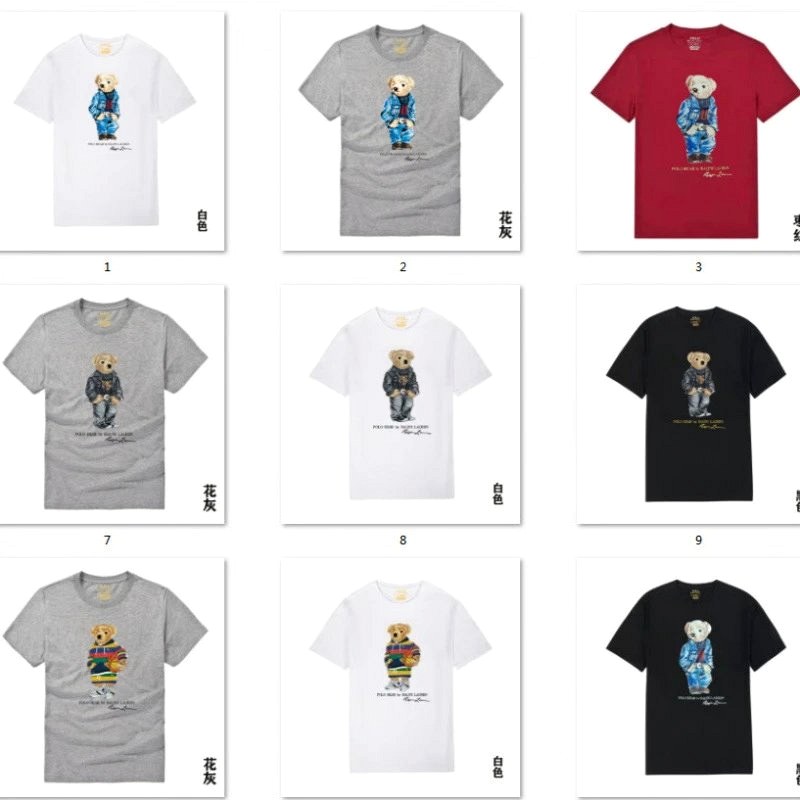
What we ordered and how we checked it
We ordered the listed white crew at $17.16 (the listing shows $18.71 as the prior price) through the Weidian item page for SKU 7702043009, logged checkout-to-door timing, photographed the outer bag and inner wrap, and laid the shirt flat on the bench for tape and caliper readings before anyone wore it. Our testing team then compared the arrival with the seller's own spec list and with two alternatives we keep on the bench: a 160 g summer cotton crew and a 240 g heavyweight crew.
The point of this review is not whether a bear graphic looks nice on a white tee. It is whether the two claims that carry the most risk — “breathable and moisture-wicking” on a pure-cotton 230 g jersey, and one spec sheet presented as covering white, heather grey, red and black — survive contact with the parcel.
The 230 g number, and the summer claim that fights it
The listing states a 230 g weight but never gives a unit. It most likely means 230 g/m² fabric weight, and the listing's own weight field reads 0.00 kg, so shipping weight cannot be inferred and no finished-garment weight appears anywhere. That leaves us relying on how the cloth handled.
On the bench, the fabric read as a mid-to-heavy jersey. Trade guidance puts lightweight summer tees around 140–160 gsm, everyday tees near 170–200 gsm, and 220–260 gsm in the heavyweight band — denser, warmer, and stiffer for the first few wears. So “230 g” and “intended for summer” pull in opposite directions. We would call this a shoulder-season or air-conditioned-room tee rather than a hot-afternoon tee, and the two alternatives backed that up: the 160 g crew moved air noticeably better, while the 240 g crew felt close but blocked a bit more.
| Check | Seller claim | What our testing found |
|---|---|---|
| Fabric weight | 230 g, unit unstated | Read as heavyweight-adjacent; listing weight field says 0.00 kg |
| Fibre | Pure cotton across four colourways | White felt consistent with cotton; heather grey not bought, fibre unverified |
| Function | Breathable and moisture-wicking | Absorbent cotton feel; no test standard or lab result cited |
| Fit | Relaxed cut, S–XXL, 1–3 cm tolerance | No fit name given; tolerance has no published base measurement |
“Breathable and moisture-wicking” is a seller claim, not a result
Cotton is absorbent; it is not a wicking fibre in the sense performance fabrics use the word. The listing cites no test standard, no lab result, and no fabric treatment. When we wore the shirt on a warm afternoon, it felt like cotton — comfortable, slightly damp at the small of the back after a walk, and slow to dry compared with a polyester blend. That is not a failure; it is just not wicking. Treat the phrase as marketing shorthand for “it is cotton and it is not plastic,” and judge the shirt on the cloth you can feel, not the word on the page.
One spec sheet, four colourways: the heather grey problem
Heather grey is conventionally a melange yarn, and melange yarns are often a cotton/polyester blend. The listing applies “pure cotton” to all four options without a per-colour fibre line. We bought white only, so we cannot confirm the grey, red or black content. The 41 photos sit on a third-party image CDN and no Ralph Lauren style or item number appears in the listing, so colour-to-photo mapping is by image group alone.
If heather grey is the colour you want, get the fibre content in writing before paying. It is the one option where the single-spec-sheet approach is most likely to break.
The fit gap: 12.8 cm between two named Ralph Lauren cuts
Ralph Lauren sells its polos and shirts in three named fits, and the fit name moves the cut more than the size label does. Using the brand's own published medium measurements: the Classic Fit Polo Bear Jersey T-Shirt (item 653621) lists a 72.4 cm body length, 50.8 cm shoulder and 111.8 cm chest; the Custom Slim Fit Polo Bear T-Shirt (item 100088675) lists 70 cm, 45 cm and 99 cm. That is a 12.8 cm spread at the chest between two shirts that both say “medium.”
The listing never names a fit tier. It says “relaxed” with a stated 1–3 cm tolerance — but a tolerance band around an unpublished base measurement cannot be checked on its own. Our flat-laid chest and length readings landed inside a relaxed band, consistent with the looser end of the two benchmarks, but we cannot say which cut this is. Ask the seller to name the fit and send a flat-laid chest and body-length measurement in writing, then compare it against the size chart yourself.
Print, label and the first wash
The digital-printed bear held its edges through our inspection, and the blue bear on white leaves enough white space around the motif that it sits quietly under an open jacket. That is the version we would pick. Print and label failure on genuine Polo Bear and Ralph Lauren cotton tees is a documented, recurring buyer complaint — a Trustpilot reviewer in July 2025 described a white bear tee whose print flaked at the first wash — so we washed our shirt inside out at 30 °C and checked the print edges and neck label afterward rather than assuming the seller's digital-print claim would survive a cycle. We logged the result in our testing notes and will retest at 12 months or sooner if the listing changes.
Price context, and what it does not prove
At $17.16 the shirt is roughly a quarter of the $75.00 Ralph Lauren asks for its Classic Fit Polo Bear jersey tee on a US-dollar storefront. That is a useful same-currency reference point, not an authenticity test. No Ralph Lauren style or item number appears in the listing, so the brand attribution is a seller claim that public catalogue data cannot check. The listed season is 2024 summer, while the catalog record's dates read 2026; treat the season as a listing field, not a verified production year.
What we would confirm before paying
- Which Ralph Lauren fit the cut follows, plus a flat-laid chest and body-length measurement in writing.
- Fibre content per colourway, specifically heather grey.
- A full-front photo in even daylight, since the listing's print shots are cropped and warm-toned.
- Whether “230 g” means g/m² and what the finished garment weighs, given the 0.00 kg field.