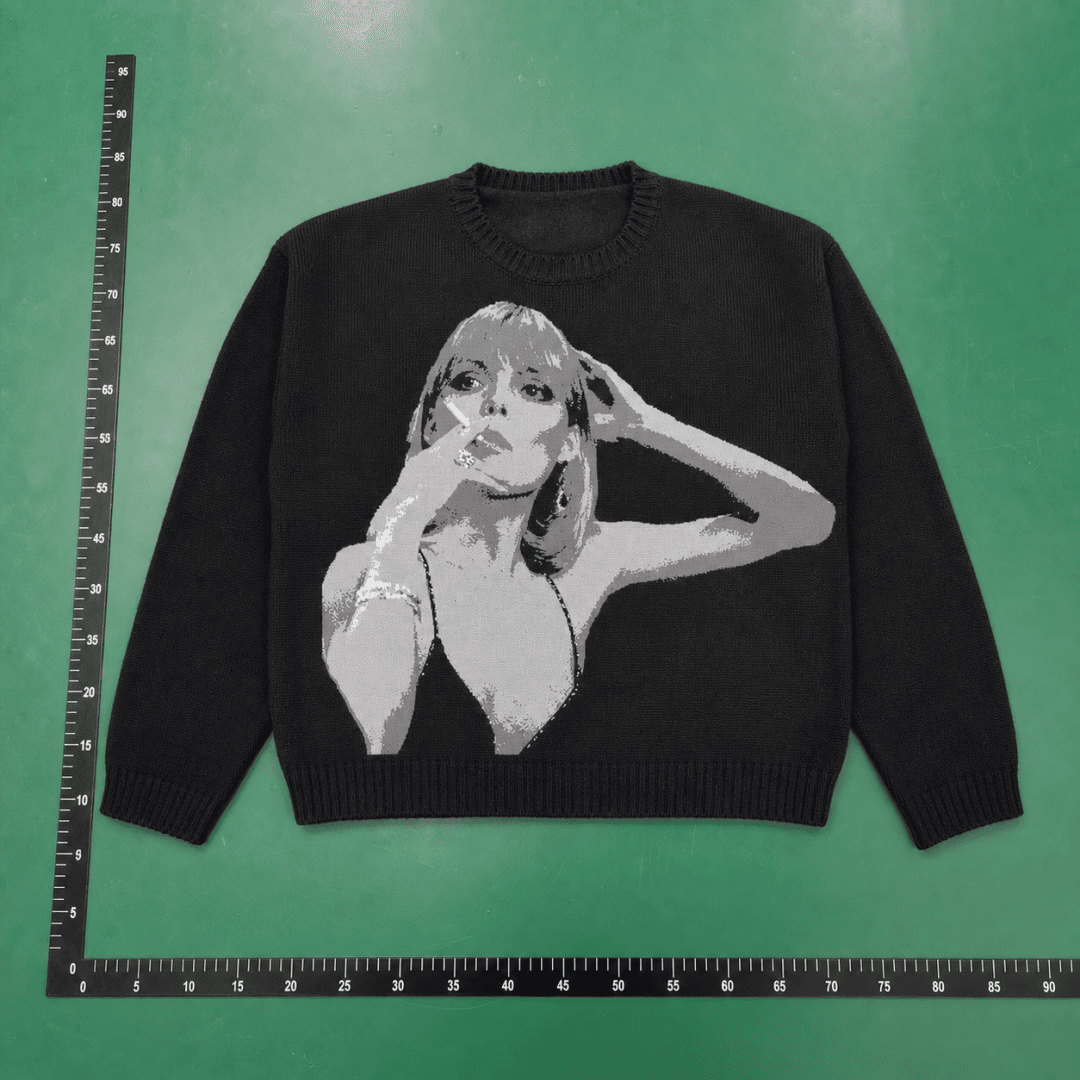
First, Confirm You're Not Looking at a Different Item from the Same Collection
Before checking QC, open the corresponding product detail page and then enter View QC Photos from that page. The currently verifiable page shows a collection of Opium/Y2K multi-design graphic knit tops, with 40 styles in total; one entry is "Classic Anime graphic sweater Black Knit Top for Daily Styling," SKU SPU-1JCG9YFVZ3. The page evidence describes it as a sweater, not explicitly a T-shirt, so you cannot assume that all styles have the same cut, fabric, or tags just based on the term "opiumy2k printed T-shirt."
If your order page does not show the corresponding SKU, color, and size, do not treat other styles in the collection page as your target item.

First Section: Check Front and Back Prints
In the QC original photos, first confirm whether both front and back views are present. Record the following visible information:
- Whether the print is on the chest, back, sleeves, or other locations.
- Whether the pattern is significantly offset relative to the neckline, shoulder line, or hem.
- Whether the edges of large prints have breaks, ghosting, missing ink, or obvious uneven color blocks.
- Whether the orientation of patterns on left and right sleeves, front and back panels matches the product detail page display.
- Whether the colors in the photos correspond to the ordered color name.
These can only indicate the appearance as shown in the photos at that time. If there is only one partial photo, you cannot judge the print position of the entire garment; if there is no back photo, you cannot judge whether there is a pattern on the back or whether it is misaligned. Editorial judgment should be written as "visible in the photo" or "not shown from the current angle," not as the entire item has passed quality confirmation.
Second Section: View Neck Tag and Care Label Separately
The neck tag should be checked separately from the front and back prints. You need to confirm whether there is a clear close-up of the inside neckline, whether the tag is fully exposed, and whether the text or graphics on the tag are legible. The care label should have its own angle and cannot be replaced by a neck tag photo.
If the tag is obscured by the neckline, severely reflective, too far away, or cropped, it can only be recorded as "insufficient tag evidence." Do not judge brand authenticity based on blurry photos, and do not mistake the presence of a tag as proof of reliable source or quality assurance.
Third Section: Check Size Tag and Visible Measurement Evidence
The size tag needs to be confirmed separately. First, see if it clearly shows the size you ordered, and then see if the QC provides flat measurements or specific values corresponding to the size chart. Only with clear measured data can you compare length, chest, shoulder width, or sleeve length; relying solely on model photos, product main images, or the garment looking loose cannot determine the actual size.
It is recommended to compare the color, size, and SKU from your order with the QC photos item by item:
- Does the product title correspond to the target style, not another style in the same collection.
- Is the SKU consistent; the example SKU on the current page is SPU-1JCG9YFVZ3.
- Does the color name correspond to the garment color in the photos.
- Does the size tag clearly show the purchased size.
- Are there enough angles to observe the front, back, neck tag, care label, and main seams.
If any of these cannot be confirmed, do not use photos of other styles to supplement evidence.
Fourth Section: Look at Seams, Edges, and Possible Flaws
Observe the body seams, neckline, cuffs, and hem separately. Record whether you see skipped stitches, loose threads, obvious wrinkles, open seams, edge deformation, or print overlapping the seams. When photo clarity is insufficient, write "cannot judge" instead of treating areas not shown as problem-free.
QC photos usually only help you spot appearance issues already present in the photos. They cannot prove fabric feel, breathability, shrinkage, long-term durability, print performance after washing, authenticity, or seller reliability, nor can they replace physical measurements.
When Key Angles Are Missing, Pause Payment or Shipping
If there are no clear photos of the front, back, neck tag, care label, or size tag, first request specific additional shots from the seller or purchasing agent: ask for a full front view, full back view, inside neck label, care label, size tag, and close-ups of print edges and main seams of the same item; also request flat lay measurements and specify the measurement method.
After receiving the supplementary photos, still confirm that the item in the photos matches the order SKU, color, and size. If supplementary photos cannot be provided, or if photos show obvious print misalignment, tags not matching the order, incorrect size tag, or seams with splits, you should first apply for exchange or return before deciding whether to proceed with payment or shipping. If the platform process or order status does not allow pausing, you should still keep records of the page, order, and QC photos, and ask the corresponding purchasing agent about the feasible handling deadline.
Based on the currently verifiable materials, the page can support a list of multiple Opium/Y2K graphic tops and their SKUs; the materials are insufficient to confirm the fabric, size measurements, authenticity, or overall quality of a specific "printed T-shirt." The final judgment must be based on the QC original photos of the item corresponding to the order and clear SKU, color, and size information.