Are ebaybuy Walking Shoes Worth Long-Term Wear?
Are ebaybuy Walking Shoes Worth Long-Term Wear?
Are ebaybuy Walking Shoes Worth Long-Term Wear?
If you're considering buying a pair of walking shoes listed as Nike black and white fashionable sports shoes on ebaybuy, what you really need to judge is not the brand name or appearance on the page, but whether they fit your walking frequency, road conditions, maintenance habits, and acceptable cost.
This article addresses a specific question: when you can't confirm actual lifespan from the product page alone, how do you judge whether a pair of shoes is worth wearing long-term, and establish a reviewable cost record before ordering? After reading, you'll be able to do three things: verify product page information, estimate cost per wear, and create a post-purchase wear review table.
This article does not apply to scenarios requiring medical-grade foot support, competitive race walking, trail running, or compliance with specific safety standards. The brand labeling, appearance, and price on the product page cannot replace independent verification of authenticity, materials, support structure, and actual durability.
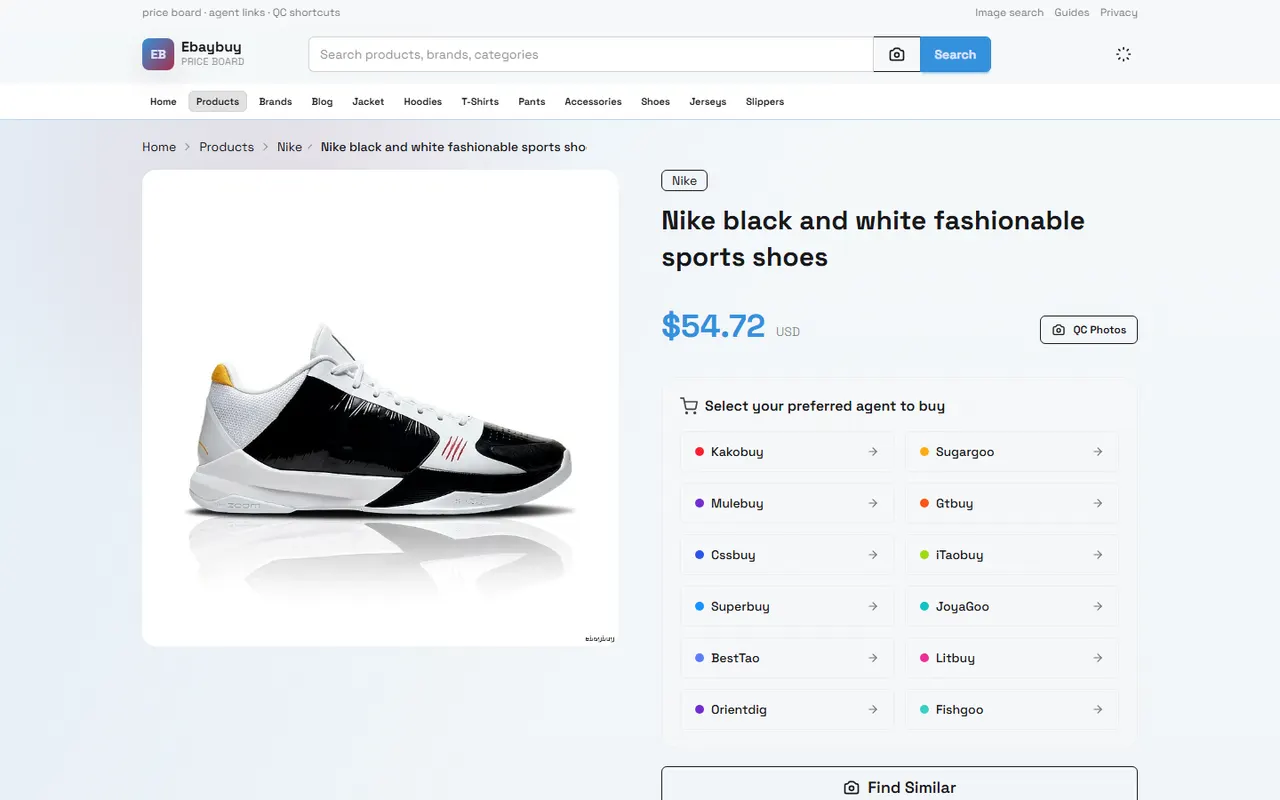
Image: The ebaybuy product page sample shows Nike black and white fashionable sports shoes, priced at $54.72, with a QC Photos entry. The above page information was verified on October 1, 2026; prices, inventory, page features, and link status may change.
Define Walking Distance, Frequency, and Usage Period
Don't start by asking "How long will these shoes last?" Instead, define your usage task first. Daily commuting, weekend walks, and occasional short outings wear shoes at very different rates.
Before purchasing, record the following:
Expected days worn per week
Approximate distance or time per walk
Main surfaces: indoor floors, sidewalks, asphalt, gravel, or wet and slippery roads
Whether long periods of standing are required
Whether they will be used in rain, hot environments, or high-humidity areas
Whether you can prepare a second pair for rotation
When you plan to reassess after several months of use
A simple initial plan can be: record continuously for 8 to 12 weeks, rather than judging lifespan based on impressions. "Worn for half a year" doesn't indicate wear level; the key is how much distance was actually walked, whether the shoes dried thoroughly, and whether the same pair was used intensively over a long period.
👟 If worn only once or twice a week, the upper may remain newer, but glue aging, storage environment, and moisture still need attention. If worn daily without rotation, the outsole and insole usually show visible changes faster.
Distinguish Product Page Specifications from Lifespan Judgment
As of October 1, 2026, the provided ebaybuy page sample shows: the product title is Nike black and white fashionable sports shoes, priced at $54.72, with page entries such as QC Photos, Secure Checkout, and Easy Returns.
This information only supports the following judgments:
There is a product listing that can be verified
The page displays a USD price
The page provides an entry to view QC Photos
The page presents purchase and after-sales related features
This information cannot directly prove:
Brand authenticity
Actual materials of the upper and midsole
Outsole rubber formula or abrasion resistance level
Whether the last fits your foot shape
Whether the sole bonding is sufficient for long-term use
Whether the page price includes international shipping, service fees, taxes, or other charges
Whether Easy Returns applies to your destination country, order status, and specific return reasons
Therefore, product page specifications and lifespan judgment must be separated. Specifications are what the page explicitly states; lifespan judgment requires support from QC photos, size information, structural details, actual usage records, and subsequent wear evidence.
Record Upper, Sole, and Maintainable Parts
Before ordering, treat the QC page as a structural check, not as proof of durability. The focus should not be on "whether the photos look good," but whether the photos can answer the following questions:
For the upper, check whether the left and right shoes are symmetrical, whether stitching is continuous, whether there is obvious glue overflow or cracking at seams, whether the toe box has indentations, and whether there is obvious deformation near the lace holes.
For the sole, observe whether the outsole tread is complete, whether the tread pattern is consistent on both shoes, whether there are abnormal gaps in the forefoot and heel, and whether the bonding edge between the outsole and midsole is lifting or has uneven glue lines.
For internal and maintainable parts, try to confirm whether the insole is removable, whether the laces are easy to replace, whether the upper is suitable for regular wiping, whether the outsole grooves easily collect dust, and whether there are structural dead corners inside the shoe that are difficult to clean.
If the QC photos only show distant views or a single angle, record it as "unable to confirm," and do not interpret unclear visibility as "no problem."
Quality judgment can be recorded in three layers: "visible evidence, missing evidence, subsequent verification":
Visible evidence: seams, tread, size markings, or structures actually visible in the photos.
Missing evidence: sole sides, shoe interior, insole, bonding areas, or details not shown.
Subsequent verification: items that need to be re-photographed and recorded after receipt.
This method is more reliable than relying on the product title alone, and avoids mistaking "brand name" for "durability guarantee."
Estimate Cost Per Wear by Usage Frequency
Long-term value can be initially estimated with a transparent formula:
Cost per wear = Actual total product cost ÷ Estimated effective number of wears
Actual total product cost should not be filled with just the page price; it should include international shipping, service fees, taxes, potential costs from returns and exchanges, and necessary cleaning and maintenance expenses based on order details. If these costs are not yet confirmed, list them as "to be verified" separately, and do not fill in a seemingly precise number.
The numbers below are for demonstration only and are not a promise of the product's lifespan. Assuming we temporarily use only the displayed product price of $54.72, excluding shipping, taxes, service fees, and after-sales costs:
Usage Assumption | Estimated Wears | Cost per Wear Based Only on Product Price | Suitable Judgment Method |
|---|---|---|---|
1 time per week for 6 months | About 26 times | About $2.10 | Observe whether occasional use maintains structural stability |
3 times per week for 6 months | About 78 times | About $0.70 | Focus on outsole, insole, and upper creases |
5 times per week for 6 months | About 130 times | About $0.42 | Need to focus on rotation, drying, and road wear |
These results only show how changes in the denominator affect cost, and do not indicate that the shoes will definitely reach the corresponding number of wears. If the actual total expenditure is $80, or the effective number of wears is only 40, the cost should be recalculated.
A more prudent approach is to set three record points: first wear, 20 wears, and 50 wears. At each point, photograph the sole, toe, heel, and upper creases, and record any slipping, unusual noise, glue separation, deformation, or decreased comfort.
Check Outsole Tread, Bonding, and High-Wear Areas
For walking shoes, outsole wear is often more indicative of value than whether the upper looks old. When checking, keep the same photo angles to allow comparison.
Focus on the following areas:
Outer heel: common for people with outward landing or asymmetric gait
Inner and outer forefoot: can reflect concentrated wear on push-off areas
Center sole grooves: check if tread has become noticeably shallower
Toe flex area: check for creases, cracks, and material fatigue
Bonding between sole and upper: watch for lifting edges, glue overflow changes, and partial separation
Heel area of insole: check for collapse, sliding, or loss of support
If the sole has localized wear, significantly reduced wet traction, open glue joints, or rapidly increasing wear differences between left and right, you should not continue to use "still wearable" as the only criterion. These changes can directly affect safety on wet surfaces, stairs, and long walks.
Compare Cleaning, Drying, and Rotation Plans
Maintenance cannot turn ordinary shoes into wear-resistant shoes, but it can reduce additional damage from moisture, stains, and prolonged concentrated use.
Recommended basic plan:
After wearing, let them air dry in a ventilated area; do not stuff wet shoes into sealed storage bags for long periods
First remove particles from the sole, then treat upper stains, to avoid hard particles repeatedly rubbing the material
Use gentle cleaning methods, and test in an inconspicuous area first
Do not use high-temperature drying without confirming material heat resistance
Remove the insole and dry separately to reduce moisture accumulation inside
If walking long distances daily, try to have a second pair for rotation
Record the date after each cleaning to avoid mistaking temporary dryness for structural recovery
The value of rotation is to give the upper, insole, and internal environment more recovery time, but it also increases the upfront cost of buying a second pair. Whether rotation is worthwhile should be based on your actual walking volume and the cost per wear of the shoes, not a fixed conclusion that "all shoes should be rotated."
For example, if one pair handles daily commuting and evening walks, and another pair only handles shorter routes, it may reduce concentrated wear on a single pair; but if both pairs are rarely worn, the extra expense may not translate into lower long-term cost.
Identify Unverifiable Durability Claims
When the product page contains descriptions like "sports shoes," "high quality," or "durable," first ask: does the page provide reviewable evidence?
The following usually cannot prove long-term durability alone:
Only brand or series name
Only a distant product photo
Only seller adjectives without material, structure, or size details
Only a QC mark without specific QC photos
Only user review summaries without verifiable usage periods and road conditions
Only "suitable for daily wear" without applicable distance, weather, or foot type descriptions
For content not disclosed on the page, mark it directly as "unknown" rather than filling in assumptions. Especially do not infer sole softness, support strength, breathability, or actual abrasion resistance from appearance.
If information between the product page, QC photos, and order process is inconsistent, pause the purchase and save screenshots of the page at that time. Prices, inventory, return conditions, and available routes are all facts that may change; reconfirm before purchasing.
Complete Long-Term Use Checklist Before Ordering
Before preparing to order on the ebaybuy page, check in the following order:
Record product title, page price, currency, and page verification date.
Confirm whether the page provides clear product details and viewable QC Photos.
Check whether there are sufficient angle photos for the upper, sole, interior, and bonding areas.
Record your foot length, foot width, usual sock thickness, and target size, and compare with page size information item by item.
Record product price, service fees, international shipping, taxes, and potential return costs separately.
Do not interpret "Easy Returns" as unconditional free returns; check destination country, return window, responsibility determination, and cost bearing.
Confirm your use scenario is not professional sports, trail, or requiring special medical support.
Set initial inspection items after receipt and review points at 20 and 50 wears.
Keep doubts about unconfirmed structures and materials; do not replace evidence with marketing terms.
If total cost cannot be calculated, mark the order as "to be verified" first; do not judge value based only on product price.
🧾 The focus of this checklist is not to find an absolute answer, but to break "worth it or not" into reviewable decisions: whether it fits your task, whether evidence is sufficient, whether cost is acceptable, and whether risk is within your tolerance.
Post-Purchase Maintenance and Review Records
After receipt, do not treat product page claims as results. First check whether the actual item matches the page, and save necessary order and QC records. When displaying or sharing screenshots, cover order numbers, names, phone numbers, addresses, payment information, and complete shipping labels.
Suggested review fields:
Receipt date
First wear date
Walking time and road surface for that wear
Whether the upper has obvious defects
Initial outsole tread condition
Whether the insole and heel are even
Whether there is slipping, friction, unusual noise, or discomfort after wearing
Cleaning and drying dates
Current cumulative number of wears
Whether glue separation, cracking, deformation, or reduced traction has occurred
Whether still suitable for the original use scenario
Each record should use the same lighting and angles for photos. If problems occur within the return window, save evidence according to the applicable rules on the order page first, then decide whether to initiate after-sales. Do not repair, clean, or alter the product yourself to prove quality issues.
Final Judgment: When Is It Worth Long-Term Wear
This pair of shoes is more likely to be suitable for long-term use if: your walking task is an ordinary daily scenario, the size and foot shape match, QC photos cover the main structure, the actual item after receipt matches the page information, the outsole does not show abnormal concentrated wear at review points, and the total cost is within your budget.
Do not use the "low price means good value" judgment. The displayed $54.72 can only be a sample product price, not representing the final landed cost or the actual effective number of wears.
Adopting rotation, cleaning, and natural drying plans may reduce concentrated wear on a single pair and keep cost per wear acceptable over a longer period; the trade-off is the need to buy rotation shoes, occupy storage space, and manage more orders and after-sales. Rotation is suitable for people with high-frequency walking, regular maintenance ability, and a focus on stable use.
If your main goals are wet surface safety, professional sports performance, orthopedic support, or extremely high mileage durability, and the product page cannot provide sufficient structural and material evidence, you should not order based solely on appearance, brand labeling, or page marketing terms. In this case, waiting for more complete QC information, or choosing a product with more sufficient evidence and clearer applicable standards, is usually more reasonable than bearing return and usage risks afterward.
Finally, keep purchase date, verification date, total cost, number of wears, and outsole condition in the same record. Only then can you answer "worth long-term wear" after actual use, rather than guessing before ordering.
Agent Platform Shopping FAQ
1. In what way can a buyer on ebaybuy.net check the quality of an item?
When you shop on ebaybuy.net, look closely at the inspection images rather than the pictures supplied by the manufacturer, since those are commonly edited. Use the inspection photos to see if the product matches your exact expectations for fine details before you commit to buying. Additionally, remember that products offered at unusually low prices on ebaybuy.net are generally not high quality.
Browse our latest products and find your next favorite item.